Saturday, May 29, 2010

Ultimate Challenge! The List Of Awesomeness!

So, I had this thought. In the grand tradition of such epic events like 10 Comic Book Characters You Hate Day and the eight kajillion events happening daily at Comics Should Be Good, I had the following thought:

My recent stand-on-the-K-Box-and-tear-down of Brightest Day #1 made me think--You know, I like comics and all that, but I seldom seem to say so. And I don't want to constantly harangue people about shitty comics all the time (which is one of the reasons that the Prattle has exceeded its comics remit from time to time) lest I get so pissed off I forget why I liked them in the first place.

So I thought I'd redress that this way--by giving you ten awesome things from comics. Chris Sims has Batman tossing a car battery, TV Tropes calls them Crowing Moments of Awesome, and these ten things are my equivalent of that--they are the stuff that got me to love comics in the first damn place. Now, all of these aren't from comics, but they're in that spirit.

These aren't in any particular order, positively loaded with spoilers, and probably aren't explained in any great detail (or I'd have another humongous series of articles that I procrastinate about writing) they're just a list of 10 awesome things about comics. If you ain't feeling that, or you're too soaked with hipster irony, then dammit, this ain't for you.

Here we go:

1. IRON MAN #200--"My friend is dead . . .others may have been captured, taken who knows where . . .I could have stopped him before it got to this point, but I didn't. But I will. I'll accept the responsibility that goes with who I am and I will stop Obadiah Stane."

Cue the rollout of the Silver Centurion armour, a battle with Stane 30 issues in the making, and Tony Stark becoming Iron Man once again.

2. JUSTICE LEAGUE UNLIMITED-"Divided We Fall." Braniac and Luthor are one being (to Alan Moore's eternal regret, Braniac's head is not worn as a hat), and powerful enough to hold the entire Justice League at bay. The only one with a chance of stopping them is The Flash . . .who proceeds to run around the entire world and lay on a beatdown so epic it traveled back in time and caused the Tunguska Explosion:


3. CRISIS ON INFINITE EARTHS #10--Obviously, myself and MightyGodKing are the only folks who like Crisis (or would, in fact, admit it in public) and enough people out there already have already mentioned the more well-known moments, but for me, even though it doesn't end well for anyone concerned is this moment in Crisis #10:

The Anti-Monitor has tricked the united heroes and villains to travel back to the dawn of time itself and begins draining their power in an effort to complete his destruction of the Multiverse. It has something to do with Krona seeing the Anti-Monitor's hand rise out of the maelstrom of creation which will a) destroy everything and b) inspire Krona to star in JLA/Avengers twenty years on.

But right when this is supposed to happen, something resists him. As all good villains must, the first thing out of his mouth is "Who dares?"

And the Spectre (DC's preferred deus ex machina for decades now) backed by every magic user in the DCU, appears and replies: "I dare, cruel one! And I will stop you!"

It's a real "raise your fist in the air" moment for me, and moments like that are pretty much what I read comics for, so really everybody wins.

4. INFINITY GAUNTLET #4--Thanos has the power of God, has killed half the universe, and the only hope that remains is a gambit involving an army of Earth's Mightiest Heroes.

Guess how well that goes?
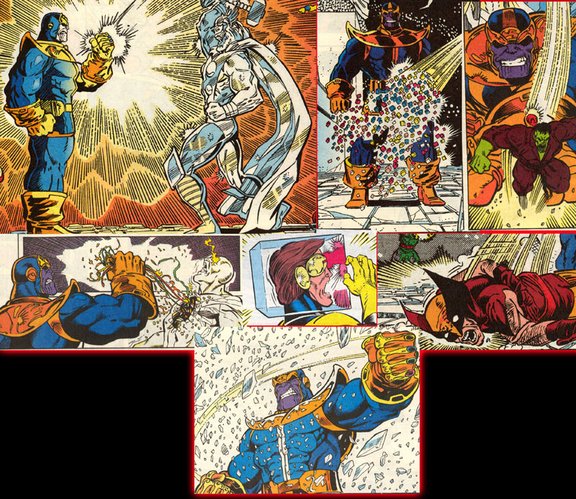
Print photo at home
And yet . . .the one guy left standing, the one guy with no powers, the one guy who basically has a trashcan lid for a weapon, will still stand up to a pissed off genocidal god:
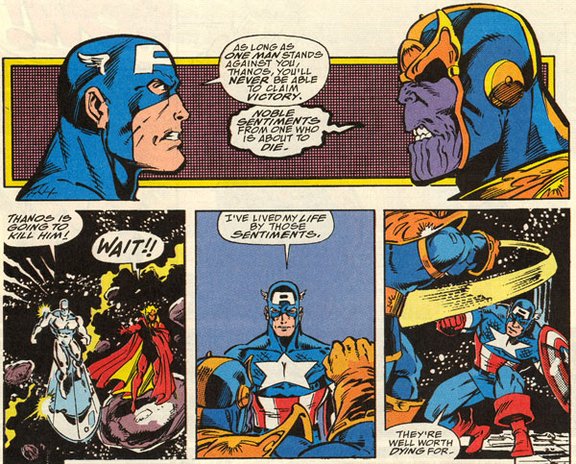
Print photo at home

. . .who breaks his unbreakable shield with contemptuous ease:
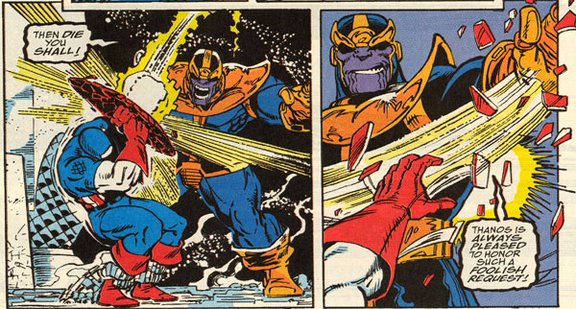
Print photo at home

. . .and Cap still refuses to back down and basically punches God in the face in response:
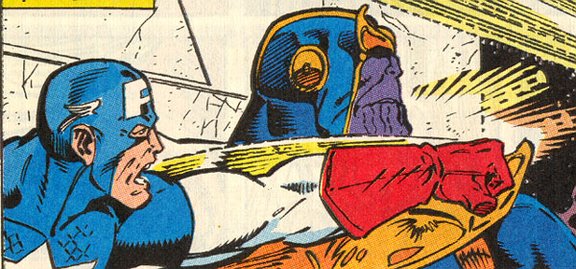
Print photo at home


Man, good thing I had all these images left over from when I covered this in the old blog. Heh.

You know, people think that speech from Civil War or wherever where he talks about planting himself like a tree next top the river of truth or whatever it said is epic. These people are objectively and consummately wrong. That's telling you how awesome Cap is. This comic showing you Captain Fucking America laying one on the jaw of the supreme being, and that is straight-up showing you how awesome Captain America is. Even if he's the last man standing, he will never surrender.

5. NEW X-MEN #150--Cyclops has had enough. The deception with Xorn is the last straw in what's been a pretty awful year for him. Resolving that he's done with the whole "repression" thing (which was pretty much his defining characteristic) declares that he's going to cut loose from now on, starting with Magneto.

By which I mean he grabs Magneto by the throat and point-blank blasts the helmet off his face. For longtime X-Men readers who'd grown used to Cyclops being the bland, unexciting and unending whiny leader, this was big-time stuff and possibly the beginning of subsequent writers making some effort to break him out of being the repressed stick in the mud.

For me though, it always gonna be the "Holy crap! Cyclops is breaking bad? Cyclops?"

6. JUSTICE LEAGUE UNLIMITED--"Clash." Just . . .this (and yes, I wish I had a better clip as well) as Captain Marvel sends an open letter to superhero comics circa 2000-present:


7. THANOS #6--In trying to eliminate his need to consume planets, Galactus unleashes a force that consumes entire realities. Lucky for him, Thanos is in the midst of a face turn and comes to his aid. And by "comes to his aid," I mean, he traps the creature on one planet, detonates an entire nuclear arsenal on said planet whilst simultaneously crashing another planet into that one. God, I love comics sometimes.

8. ACHEWOOD: THE GREAT OUTDOOR FIGHT--To win the Great Outdoor Fight, Ray Smuckles has to beat up his friend Roast Beef, who was instrumental in getting him that far in the first place. The penalty for not doing this is that they'll get run down by men in jeeps. Rather than "beat real on his friend," Ray decides that the only sensible course of action is to tear the whole Fight apparatus down.

Y'know, putting aside that the whole thing is epic as hell you can hardly imagine that this is happening in the same strip that usually does jokier fare. It also tells us that true friendship is being willing to destroy an entire organization for someone.

9. CAPTAIN MARVEL #29--Mar-Vell has just been beaten down by the Controller, who's only a Dragon for Thanos, who holds the Cosmic Cube and godlike power over . . .wow, Thanos showed up a lot on this list, didn't he?

Trapped under the wreckage of Avengers Mansion, Mar-Vell is spirited away by Eon, a cosmic entity who looks like a tree (hey, it was the 70's) and for most of the issue questions Mar-Vell about just how far he's gotten being the Kree warrior who thinks most every problem can be solved by punching it really hard. That is--not very far at all.

So he's given a chance to become something greater--to evolve into the Protector of the Universe (which still seems to involve a lot of punching, but what are ya gonna do?) and be the key to defeating Thanos (who very helpfully waits before starting up the whole "turning into God" thing so Mar-Vell can get his shit together) and Mar-Vell decides to make the change that will allow him to be what is needed.

Now, admittedly Captain Marvel is not necessarily an a-list hero, but this issue does a great job of summarizing his history and building an argument that there's potential there he should live up to. And while he doesn't fight anyone physical in this issue, that he triumphs over his inner demons feels like a satisfying enough victory in itself.

10. Oh, and last but by no means least, thanks to time and the toll it takes, comics are just about the only milieu where we Doctor Who fans could see a scene like this.

Maybe you have your own list, maybe you want to call me on bits of mine--lord knows I'm sure to have left stuff out. I'd love for this to become a thing and for other people to post ten awesome things from comics. Let's take the weekend off from gnashing our teeth about the Sentry retroactively fucking everyone. The mendacity will be here when we get back.

Friday, May 14, 2010

I Read This: BRIGHTEST DAY #1

Geoff Johns utterly confounds me.

Unlike pretty much all my follow commenters on the Internet (e.g. the ones people actually read) who find Geoff Johns to be the most toxic sort of backward-looking nostalgia-mongering since that brief flash of madness where people really cared about what Alex Ross thought of the current state of superhero comics, full stop I actually find Johns ideas rather intriguing.

At least the ones he seems to stumble onto by accident on the way to something that really pisses me off, anyhow.

You see, I like the idea of the "rainbow Lantern" corps--I can totally get behind an "arms race" of power rings, as the idea that people just fall in line and accept the authority of the Green Lantern Corps seems to be rather flimsy and in need of explanation. The Time Trapper being a constantly-shifting sentient timeline? Liked that. Hawkman's stop-and-start rat's nest of continuity being explained as imperfect perpetual reincarnations? Very clever, I thought, even if it steamrolled over John Ostrander's Hawkworld/Hawkman stuff, which I quite enjoyed.

I was even able to find stuff to like in Blackest Night that helped the stuff I didn't (the zombies, the gore, the fact that you can pretty much skip to the last 3 issues because NOTHING HAPPENS UNTIL THEN EXCEPT GODDAMN ZOMBIES) I liked the idea of deputizing heroes and villains to serve as substitute Lanterns; I liked the idea that Earth was the actual cradle of life in the universe and the Guardians had hid that fact to protect Earth and justify their authority; I liked that Sinestro, of all people, got the White Lantern power.

But of course, all these bits get pissed away, on the way to Blackest Night's ultimate denouement, wherein a great lot of heroes and villains come back to life (funnily enough, most of them died in the gore-fests of the 2000s, now that I think of it) and Martian Manhunter gets some bloody pants, Firestorm's a white guy again (not that I often agree with Chris Sims, but his article on this tendency hit the nail on the head as to why this was a terribly worrying trend, and that was before they snuffed the Ryan Choi version of the Atom), Deadman is "aliveman," and here's goddamned Aquaman back and . . .well, things just kind of sputter to a stopping point because things don't really end in the Big Two's superhero comics, one just bounces on to the next thing like a ping-pong ball in a clothes dryer.

It's a really awful ending, as you're kind of geared up for this big-ass showdown that . . .never comes. The Deputy Lanterns are gonna take down Nekron and the Black Lanterns, only they don't. Then Sinestro (who looks like Hitler and is powered by White Power--why no Geoff, that doesn't look bad at all) and he doesn't. Then Hal Jordan gives his abominable "We came back to life because we didn't feel like being dead, so there!"speech and they can't beat them and then the cavalry finally rides in and . . .fucking Aquaman? Really? Really?

And even that doesn't really solve things to any satisfactory conclusion. Nekron just kind of explodes because it seems like a good idea at the time, Black Hand gets dragged off and things just kind of fizzle out, because by God, we've gotta have Brightest Day here next week.

One would imagine that Brightest Day, by it's very name, and because it deals with the aftermath of the DCU's darkest hour and ended with resurrection, that it would have a slightly cheerier remit. Surely, the heroes who'd been dead for some time would take some time, at least, to be grateful for their second chance at life, maybe grapple with the fact that time moved on slightly, maybe . . .

. . .yeah, right. This is DC we're talking about here. Brightest Day is about as glum and joyless a comic as it is possible to make with human hands, and bear in mind two things: One--it spins out of a limited series featuring zombies ripping people's hearts out.

Two--I've read every issue of the original Faust, and it's like bloody Planet Terry next to this. It's an utterly joyless grind wherein everyone who's resurrected slogs grimly through things when they're not actively whining about being alive, and of the three black people who get any face time in the story, one is a child-molesting pirate, one whines that Ronnie Raymond is a shit Firestorm (and he is) and the last one kills a whole fish market full of white people when he hears Aquaman's back because White Power Geoff doesn't care about black people and oh yeah, he's actually Black Manta.

Now, the idea that resurrecting Aquaman should drive anyone to anything but yawns and a deep sense of apathy is frankly silly enough, but the idea that Black Manta (whose superpower, as Seanbaby one remarked, is that "he owns a boat") was just marking time in a fish market because without Aquaman to pester, life had really lost its luster is just . . .fucking dumb.

And not really in keeping with Black Manta's characterisation. He's a black guy (and because he was a black guy, he had to have "Black" in his name because we might have gotten confused) who has plans to build a homeland for black people under water. So, uh, why the fish market job? Has the recession hit supervillainy as well? How is that gonna get you any closer to Underwakanda? You have a helmet that shoot fucking lasers, man. There's options.

What else is going on on this issue? Oh, the White Power has left a White Power Battery in the middle of the street which no one can lift except whoever's worthy, Deadman's whining about being alive, and Aquaman can only summon dead sea creatures who go 'round killing everyone, which, when you think about it, makes Aquaman about 75% more useful than he is the rest of the time.

You know before, when I said that Geoff Johns tends to create stuff that I find interesting by accident on the way to annoying me about something else? Yeah, well, there was absolutely nothing of that to distract me from how goddamned annoying this comic is, and when you consider that this week had an utterly gratuitous Titans issue wherein they killed off the other Atom (because Titans wasn't enough of a gore-fest to begin with--I swear; if Wolfman and Perez had it to do over again, with the benefit of hindsight, they'd never have done the Judas Contract if they knew what dire bilge would result from the generation that thought it was the kewlest thing evar) and Paul Jenkins wrote Stupid Fucking Paul Jenkins Comic #2314, Featuring The Sentry fighting very hard to collapse everything stupid and awful about superhero comics in the new millennium into a black hole of suck, this was the rancid cherry on top of the proverbial shit sundae.

Seriously--if you were in a comic shop, this was the collectively stupidest Wednesday on record. Everyone should have walked out of the comics store hanging their heads in shame.

Going back to the Sims article for a second (lest my froth lead to more parenthetical asides--oops, too late) I don't actually believe that Geoff Johns wants to whitewash all DC characters (but White Power Geoff is too good a name not to use, and I hope someone'll get the Arrested Development reference) but shit like this doesn't help. Three black people in the issue, and they're all awfully unpleasant.

I don't want to read stuff like this. I don't want to read comics wherein a bunch of dead heroes whine about not being dead anymore. I want to read stuff like Power Girl (well, until that gets bent into shape and she starts whining and shit) --I want to see superheroes doing superheroic shit and enjoying themselves while they do it. I want to see them have fun doing it, and I want to feel like I've had a nice break from the cares and difficulties of my own life when I'm done.

And most of all, I want to know why in the FUCK these people who want the Silver Age back SO DAMN BAD seem to want everything BUT the essential optimism that characterized the fucking Silver Age brought back. I can't be the only person who's noticed this, can I?

In short, I would not recommend this book. I didn't think it was very good.

Thursday, May 13, 2010

I Read This: POWER GIRL: A NEW BEGINNING

We've talked about Power Girl a few times here at the Prattle, chiefly when she returned home in a muddled mess of an Justice Society Annual and the latest semi-annual kerfuffle having to do with her bustline. As the second one covered most of her particulars, this gives the the luxury of not having too delve into them again here.

Recently, they gave Power Girl a series, which seemed a surprising notion to most, considering her generally adversarial characterization and tortured continuity would have made her radioactive for that sort of thing.

And yet . . .it's become quite the cult hit. Perhaps it's down to the creators (to be honest, it's hard to imagine a better fit for this book than James Palmiotti, Justin Gray, and Amanda Conner) the mise-en-scene that puts Power Girl in New York City, sets her up with a sufficiently intriguing civilian identity and supporting cast, or maybe it's because this is the most upbeat, non-grim, non-gritty, just plain fun superhero book DC has managed to publish since the mandate came on high that superhero comics were Serious Business and in no way, shape or form should be considered "fun."

Having said that, Judd Winick takes over the book with issue #12, which ought to show all us fools buying the happy fun superhero book what for, eh? I expect with him at the helm, the book will sink quicker than the Lusitania, as Winick writes exactly the kind of comics I never want to read.

But let's dwell on the positive, for once--when I cover Brightest Day #1 next time there'll be plenty of negative to go around--Power Girl manages to make a character who's been so muddled actually work and this trade collecting the first six issues really shows how workable it is.

Power Girl's bewildering origin is briskly covered in the first page of the book and with that out of the way, we're straight on to the action. Someone is making New Yorkers crazy (well, moreso than usual) and raining down what looks an awful lot like the Big Daddies from Bioshock down on the island as a prelude for ripping the island of Manhattan up into the sky. It's up to Powergirl (with guest stars the Justice Society and the new Terra) to find out what's causing it and get them to knock it the hell off already.

Meanwhile, in her civilian identity as Karen Starr, PG is busily trying to rebuild her old company as a newfangled think-tank which uses bleeding edge theoretical technologies to better mankind in a Tony Stark kind of way (I have to say--the idea of using grey goo for post-superhero battle cleanup was actually pretty clever) and dealing with the hassles of obnoxious co-workers, trying to make a theoretical company turn a profit, and the perils of trying to find a new apartment that is immediately destroyed by an alien ship crash-landing in Central Park.

It's competently done superheroics with, thank God, a minimum of angst and metatextual hugger-mugger, and that alone is rare enough that I'd recommend this book, but what really puts it over the top for me is the interplay between Terra and Power Girl. I haven't read the Terra mini-series that came out before this, but somehow PG ends up as the mentor to the new Terra (who has nothing to do with Tara Markov, and good damn thing--that well is long since dry) and Palmiotti gets a hell of a lot of mileage out of Atlee's spunkiness and curiosity playing against PG's less patient, slightly more cynical attitude. It's not chemistry that one would imagine would work, but it ends up working very well and in some ways becomes the spine of the book.

And one of the reasons it works so well is Amanda Conner's art. Her ability with expressions is just staggering, whether it's Atlee and PG at the movies, PG's straining to lift a falling spaceship, or PG's adorable yet perpetually annoyed-looking cat, she really gives these characters actual character, and in an industry that currently exalts the most ghastly stiff photo-referenced crap, she's positively a treasure and one of the reasons this book works as well as it does.

In conclusion, ladies and jellyspoons, I don't care of Power Girl's never appealed to you at all or DC's utterly dunderheaded attempts to force things back to the Silver Age have completely turned you off to them, or it seems utterly futile to have a look at a book that's going to lose it's creative team soon, but you totally should, as this is (maybe) not an antidote to the mess superhero comics have found themselves in circa 2010, it certainly helps to take the pain away.

In short, I highly recommend this to you.

Friday, May 7, 2010

IRON MAN WEEK #8--IRON MAN 2 (2010)

Well, seeing as how I am the Internet's pre-eminent loudmouth on all things Iron Man (seriously! Even War Rocket Ajax said so) it behooves (behooven? does behoove?) me to weigh in my thoughts on Iron Man 2, as I am two hours fresh from the theatre having just seeing it on opening day and I can tell the Four Readers out there are dying to know what I thought of it. Spoilers ahoy--we doin' this.

Iron Man 2 picks up six months after the first movie, and Tony Stark is kicking ass and taking names. He has, as he says in the movie "privatised world peace"--an interesting concept I would rather have seen rather than be told about--as it would have been an interesting flipside to his previous monopoly on arming the world. With his fantastic suit or armor he's invincible (as people are years away from duplicating the process that created the suit), overconfident, utterly cheeky, and proves that one can indeed have balls so big that bullets do nothing as he owns the US Senate, arch-rival Justin Hammer (played by Sam Rockwell as a being that exhales sleaze the way you and I exhale carbon dioxide) in one fell swoop.

He's also dying. The arc reactor in his chest is poisoning his blood in a mostly well-thought out subplot that I was eternally grateful was not the Extremis plot as previously speculated (There are people who think the Extremis plotline in the comic was a brilliant spin on Iron Man. These people are completely, absolutely, catastrophically, objectively wrong.) The resolution is a little creaky (a lot, actually) but I'll get to that in a minute, but the way it drives Stark into more risky and alienating behaviour is actually well done and drives the story in a rather Empire Strikes Back "just keeps getting worse for the gang" kinda way.

The crisis point comes when Ivan Vanko, whose father worked with Tony's father (who, in an eternally amusing bit is played by Roger Sterling from Mad Men as Roger Sterling, pretty much) on the arc reactor thing and Swears Revenge on him. The whole attempt to set Vanko and Stark up as products of their fathers and their pasts falls flat here, mostly because Mickey Rourke hunger-dunger-dangs his way through his dialogue in a way that the word "unintelligible" doesn't even begin to cover. But he's effective physically as Whiplash and manages to make the whole "guy with a whip against the guy wearing a walking tank" thing work in a way the comics sure as hell never did.

Insofar as any of his plan was understandable without subtitles, it's pretty smart--Vanko just wants to demonstrate that Stark isn't invincible, and trusts that his many rivals will pounce him at this sign of weakness--he just plans to demonstrate it in public. But things develop that Hammer sees an opportunity to finally crack Stark's design and frees Vanko, who agrees to design an army of drones for him (though he has his Own Reasons, naturally--Hammer never once comes off as the sharpest knife in the drawer in the film. Obadiah "IN A CAVE! WITH A BOX OF SCRAPS! Stane, he ain't.) and bides his time for his final revenge with Stark.

Meanwhile, Stark seems to be taking care of the whole destroying himself thing pretty ably--alienating himself from Pepper Potts (who at least doesn't kill the Big Boss by throwing a switch this time) and finally forcing Jim Rhodes to steal one of his older suits and smack some sense into him in a pretty damn good fight that is pretty damn physical and has some decent fight choreography for something that was sure quite a lot of CGI. Credit where it's due--there's some real heft in the fights and the camera isn't all juddering around and stuff so you can't really make out what's going on. I do call bullshit on the "speed ramping" stuff though: Stop that. It's two thousand god damned ten. You know better.

Anyways, Rhodey delivers the Mark II two the government, which Hammer refits into War Machine, the Drones get built and Stark, with a little help from Nick Fury and The Most Plot-Convenient Box In The World figures out a way to upgrade the arc reactor in such a way as to where it won't kill him.

This bit is actually one of my biggest problems with the movie. Stark works out after seeing a filmed message from his father that he hid the plans for an entirely new element in the design of his expo's grounds. I know what the point of the scene was--Stark never knew his father and never knew how proud he was of him and how he'd bequeathed the future to him--I got all that without the utterly obvious & damn silly device of him hiding the new element on his fucking fairgrounds.

This is a great excuse for a new suit of armour (now with Big Triangle) and a final showdown with War Machine and the Drones on the Expo's grounds. Y'see, Vanko having figured out how to seize control of them all in an effort to . . .y'know I'm not sure what the whole point of having Hammer's Drones shoot up Stark's expo really was, and as Vanko spent more time learning hacking than he did elocution, so I can only speculate it was a general "blow up his spot" kinda thing. He was very upset about his bird maybe--I really couldn't tell you.

The fight between War Machine, Iron Man, and the Drones is a good bit of business and plays a lot better than the Iron Monger fight from the first movie did, as the multiple Drones allow for a little variety and a good long fight wherein none of the principals takes their mask off just in case the people watching are too dumb to remember who's who (I really hate this cliche, and it took me out of the fight at the end of the first movie) which has a good Crowning Moment of Awesome for Iron Man (You'll know it when you see it) and culminates with a big fight with Whiplash in his new upgraded armor.

That part I'm not so crazy about. Having read some ancillary stuff about the making of the movie, the creators of the film were anxious to avoid a fight that looked too much like the Iron Monger fight, but that's pretty much what they ended up doing. It's not bad (and has a pretty cool resolution) it's just . . .a little disappointing.

You may have noticed I haven't talked much about Nick Fury or the Black Widow being in this movie. That's because they don't really do that much--the Widow gets to kick a little ass in an ultimately futile (but amusing) bit in the third act and Nick Fury shows up to nudge the plot along, shoehorn some stuff about the Avengers movie to come, and generally be Samuel L. Jedi for a little bit.

I know everyone's nerded out about the Avengers teases that were in the movie, and . . .yeah, wonderful. It's great they're trying to link a bunch of movies together and I hope it works, but trying to do all that within Iron Man 2 meant there were a lot of bits that didn't really work for this movie that just called attention to themselves. I laud them for what they're trying to do, but really . . .it needs to be a bit more invisible to be more enjoyable, and I'm looking right at that damn post-credits bit.

Anyhow, thankfully the movie finishes on a nice callback to the Senate stuff from the beginning of the movie and we're off until Iron Man 3 hits in 2012 or whenever.

A major quibble (for me, anyways)--the score is atrocious compared to the first one. I liked how the Iron Man theme gradually "built" through every iteration of the armour was a cool little extra touch and I missed that this time out, John Debney's score is generic, obvious and too damn loud in the bits of the score that aren't AC/DC's greatest hits collection (and seriously--given how obviously mercenary having AC/DCs song jammed willy-nilly on the soundtrack, y'all didn't even try to get "War Machine?" How hard could it have been--I mean, KISS will come to my house for $100.) and it really lets the movie down when it should be at a more epic pitch. I know we're well past the days of good purpose-built scores, but when done properly, they add a lot to the movie.

It may sound like I didn't like the movie as much as the first one and . . .well, I didn't. But only narrowly so--I've told people it's an A to the first movie's A+--The armor battles are suitably epic, the suitcase armour was awesome as hell, and the movie's weaker bits are fortunately eased by Robert Downey Jr's considerable charm and amused cheekiness in the face of . . .er, everything. The rest of the cast mostly acquits themselves well--no one really stands out, but no surprise there--Downey pretty much owned the first movie also, didn't he?

In short, it's pretty good, and doesn't suffer from a dramatic slide in quality as sequels often do (and before you bring up Spider-Man 2, I remind you that people who believe Spider-Man 2 was a great movie are also utterly, tragically and catastrophically wrong) and advances the first story in some interesting ways without having to leech off of "iconic" stories from the comics (not least of which because there aren't any). The idea of Stark's Iron Man tech touching off an arms race (or an Armour War?) is a good one, and hopefully it'll be carried through to a logical conclusion in the third movie.

It's not what it was, but it'll do.

Wednesday, April 28, 2010

DOCTOR WHO: PART 3

(Hey y'all. Sorry for the delay, moving house, living out of boxes, you know how it is.)

One of the definitive moments for me in John Pertwee's tenure on Doctor Who occurs near the end of "Inferno." After being shunted to a parallel universe where everyone is a fascist (no, not that one) and on which a project running parallel to the one on the Doctor's earth has advanced to critical stage, the Doctor finds out they've inadvertently caused the planet to break apart. Everyone on this earth will die unless they can leave quickly and the Doctor, not really having the TARDIS as a resource, kind of glumly says "I'm sorry, I'm afraid you're all going to die" and then leaves them behind.

Nowadays, these little "Holy shit, the Doctor just got hardcore on these guys" is a pretty standard trope (the new series, especially during David Tennant's "lonely god" era, positively loves it) but at this point in the series' evolution, there really wasn't a moment where the Doctor was faced with an insoluble situation. Oh sure, there's always a body count on Doctor Who, but never something where a whole planet died.

There's little bits like that all through the Third Doctor's tenure, though. Because a lot of underlying Doctor Who mythos got sorted in this period, which when you consider how the whole thing started as a mad scrabble to shore up falling ratings is even more amazing.

At the conclusion of the Second Doctor's run, a few decisions were set in motion, partially because the programme wasn't drawing in the ratings necessary to justify the current approach any longer and Patrick Troughton was on his way out, and so a number of decisions were set in motion.

One, the show would now be in colour. Two, the Doctor would be stranded on Earth. No more hopping in the blue box and buggering off (except when he did) One imagines this was a budgetary decision, accepted in a desire to keep the show going more than it seemed a creatively challenging approach. In fact, they said, rightly, that it limited them two two stories--alien invasion or mad scientist.

Third, and most importantly, the Doctor would be played by Worzel Gummidge, who would play him as a debonair man of action who enjoys old cars, crushed velvet jackets, and karate-chopping people

So they had to try a bit harder to get around all that, and ultimately they succeeded. The Doctor, stranded on Earth, becomes UNIT's (an occasionally-glimpsed cannon fodder squad) scientific advisor and thus, is on hand for the threat du jour, who has plenty of UNIT cannon fodder to wade through whilst the Doctor tries to work it all out.

This bit should have really wrecked the show--one of the Doctor's most appealing traits is that of being an outsider (and more often than not a force for anarchy) and the idea of sticking him in some kind of bureaucracy should have killed the whole thing dead. However, the Doctor is barely an employee and is really just marking time until he can get the TARDIS fixed and blow this Popsicle stand first chance he gets. He frequently finds himself at odds with the Brigadier, most notably when, in the midst of trying to broker a peace deal with the Silurians, the Brigadier says "the hell with them threatening us" and kills every last one of them. The rotating cast of bureaucrats that pop up to meddle with things don't fare much better--in fact, this period of Doctor Who becomes a very anti-establishment establishment show.

That tension carries the show through some ropey and all-too-soon cliche bits. It seems almost inevitable that the latest government science project or space mission or new power plant is bound to either contain a Terrible Secret or tampering in things Man Was Not Meant To Meddle In, and after awhile that gets a bit old. One begins to fear imminent catastrophe every time someone digs a hole in the ground.

Thankfully, this is where The Master comes in.

It wasn't like they hadn't done evil Time Lords before--the First Doctor had The Monk and the Second Doctor had the War Chief, but they were either comedic figures or one-shot baddies. The Master in a whole different class. He's basically The Doctor, only evil (and a bit camp, not that you need me to tell you that) Their interplay disguises a lot of the samey bits and evil corporations and alien invasions that sometimes threaten to weigh the damn show down at times, and it injects a lot of joie de vivre into the proceedings.

Witness this clip from "The Sea Devils." It's pretty much everything awesome about the Third Doctor in two minutes:


I have no idea why they locked The Master up with a bunch of swords and guns and shit, but these are the little lapses you just learn to go along with when it comes to Doctor Who.

Oh yeah, and to celebrate the shows first decade, all three Doctors unite to battle another rogue Time Lord (well, actually Two and Three do everything, One just kinda sits in a triangle and points them in the right direction from time to time) in one of those great dream stories that kinda falls short but you don't care because holy shit all three Doctors together (It's kind of a standard thing--whenever you see characters who never mix usually, there's a certain rush that strikes you--fans of Ultraman and Kamen Rider have an idea of what this is like, and if comics hadn't so neutered the idea of crossover, you'd get that feeling in comics too) It also establishes the trope that whenever the Doctors get together, they tend to bicker a lot (we'll bring that up seven parts from now) the episode is a bit slight, but you're not really watching it for the plot as much as you are the event.

Another bit they kinda picked up and dropped was the Third Doctor having romantic feelings (no, RTD, didn't pull this out of his ass when the show returned in 2005) for his second companion, Jo Grant. To be fair, this really doesn't come to a head until her final story, "The Green Death" (subtlety has nothing to do with Doctor Who titles) wherein she runs off an marries the head of some damn hippie commune "who seems very much like the Doctor" and the Doctor gets all sombre and leaves it's underplayed and just as well, because it's kinda . . .icky. I mean, he's several orders of magnitude her age.

Anyways, by the time of the Third Doctor's final season, he's back traveling through time and space again, and he's picked up Sarah Jane Smith, who becomes one of the most enduring companions in the shows history (seriously, she got her own spinoff twice over, for God's sake) the Daleks have returned ("final end," my arse) and the Doctor is tooling around in a rather sharp-looking flying saucer.

And it's about here things change once again, as Number Three has a run-in with some spiders (they are very big spiders, in his defence) and, as the Brigadier says, "here we go again."

Join us next time when the Doctor goes all "teeth & curls" and the running of Doctor Who after Mister Rogers' Neighborhood warps a young child/future blog writer in a small North Carolina town for all time. Tons have been said about Tom Baker as the Fourth Doctor, so please stay tuned for even more of that. I would totally be your best friend if you did.

Sunday, April 4, 2010

DOCTOR WHO: PART 2

Continuing our discussion of all things Doctor Who from last time . . .

Or rather we will, but first, I gotta say, Matt Smith's debut was one of the strongest debuts of a new Doctor ever. While the episode's plot wasn't amazing (well, the parts that didn't focus on the Doctor's rather peculiar relationship with and effect on Amy) Number Eleven seems like such a natural as the Doctor I'm really looking forward to his tenure and seeing where he goes with it. Oh yes, and the roll call moment was a real "punch your fist into the air" moment, wasn't it?

Now, on to the main attraction--when last we talked, the First Doctor was on the way out and the Second Doctor was on the way in. The show had become popular enough to continue, but the actor who played the main part, William Hartnell couldn't really continue the role due to health reasons. Ordinarily, replacing the title character's actor is suicide for the show, but there was no way forward, so metaphorical dice were rolled, and it was decided that since the Doctor was an alien, why couldn't he change completely when necessary?

And thus, the concept of Regeneration was born. And the Doctor changed into that guy from The Omen who gets killed with the falling steeple.

Again, as with the First Doctor, not many of the early Second Doctor stories really exist anymore, so it's hard to tell just how much fidelity the Second Doctor had to the original's remit in the early days, but whatever the notion, he soon became his own character, who was quite different from the First's.

The most obvious difference was he predilection for comedy. Whereas the First Doctor was cranky and unctuous, the Second was more personable and prone to slapstick in moments. But at the same time, he was willing to be devious, when he has to be--the cliche of the Doctor playing dumb only for it to be revealed in the final episode that he's been playing a long game all the time really starts here, and that dynamic of "what exactly is he up to" is one of the driving forces of the show.

Another, of course, is relationship with his companions, or rather, the companions which stuck with him the longest. Jamie is a well-meaning dunderhead picked up from the Highlands who basically is there to do some of the action bits, play off the Doctor, and (as the actor once said) "Give the girls a reason to put down their knitting." Zoe is there to handle the technobabble, be a charming naif, wear sparkly jumpsuits and be something for the dads watching. It's a very sturdy chemistry, and the three of them play off each other so well, that this is another element that moves the show forward.

The last, and the most characteristic of this era, are the monsters. The Daleks seemed to be the thing that really made people tune in, so for awhile there, every writer of the show seemed determined to create the new marketable monster. The Cybermen were an early success (and appeared fairly frequently in the course of the Second Doctor's tenure) but there were others that may not have endured but are fondly remembered, like the Ice Warriors and the not-quite-as-threatening-as-advertised Yeti. Some, like the Krotons and the Quarks, never made the grade. The change towards monster-centric stories is helped immensely in places by the black and white photography, which creates some very evocative moments, like the Cybermen's march on London in "The Invasion."

In addition, there are a few threads that go through his tenure, specifically the advent of one Lethbridge-Stewart, who recurs through several stories and plays a major role in the next era and in the Second Doctor's last series, he fights an evil Time Lord (yes again--but not played for comedy this time)

One more major thing to mention is the Second Doctor's last serial, "The War Games" is the last of the "epic" Doctor Who serials, clocking in at 10 episodes. From now on, when the show takes on "epic" stories, they'll usually be broken down into arcs of related serials, more than one long story. Oh, and it also introduces and names for real and proper the Time Lords, but really, who remembers them?

It's not all good for the show, of course. For one, the effects budget is still laughable and sometimes, things fall short of the mark. The aforementioned Yeti (who look like a shaggier version of Grimace from McDonaldland and whose roar is the sound of a toilet flushing) are one example. The (sadly) mostly-lost story "The Underwater Menace" is another:


. . .really looks wet, doesn't it?

There's also (also lost) "The Evil Of The Daleks," which takes mighty and determined leaps to show and let us no in uncertain terms that the Daleks have reached their end, their final end, and any Dalek serials you may have seen after that are merely the products of a deranged imagination.

Also, dear God are there a lot of bases under siege in this era. And heaven help you if the serial you're watching runs six episodes, because you are doomed to some very obvious padding. The one that springs most readily to mind is "Tomb of the Cybermen," wherein the Doctor and the baddie fight over a damn switch for an entire episode and the Cybermen pop out of the tomb . . .and back in . . .and back out . . .

But sometimes, it works out in spite of things. Perhaps it's because the principals are so good at creating a lighter touch and acting like they're in on the joke. Most wonderfully (for me, anyways) is (also mostly lost--dammit) is "The Enemy of the World," wherein Patrick Troughton does double duty as the Doctor and Salamander, ruler of the world and in possession of an accent that starts as Spanish, meanders around the globe a bit, and settles on "generic foreign." It's an utterly silly episode full of Salamander chewing scenery so bloody hard it's a wonder Troughton didn't get polystyrene poisoning. Even intact, it would never be a good episode, but it sure as hell was a fun one.

It's definitely an intriguing era, as the balance between the more childlike (in moments) Doctor and the harder-edged monster-heavy stories shouldn't work, but sure enough it works, and while Doctor Who is no longer an educational show (well, it might be, but heaven knows what lessons you'd learn from it--how to shove Daleks around?) and has changed into something else in an effort to stay relevant and survive.

Which, to no one's surprise, is what happens at the end of the Second Doctor's tenure. In the wake of "The War Games," the Doctor is forced to regenerate and stranded on Earth. While this is a rather big risk (as it trips up one of the main strengths of the concept--that one can hop in the TARDIS and go somewhere else just in time for next week) and, as mentioned by the newer folks coming in, it limits one to stories involving alien invasions or mad scientists pretty exclusively.

However, believe it or not, it's going to work, as we'll see next time, when the Third Doctor stumbles out of the TARDIS and the show changes yet again. Karate chops for everyone!

Wednesday, March 31, 2010

V For Vituperation

So, after a deeply inauspicious initial 4 episodes, V has returned to the airwaves once again.

Before it came back the people behind the show did an extensive damage control tour, assuring potential viewers that yes, things would start happening and the show wouldn't be the dull muddled mess that tries and fails to blame every nutty conspiracy on lizard aliens like they're writing David Eick fanfic or something.

And while there were signs that things were finally going in some kind of direction (our Ham Tyler analogue finally showed up, and well, he's no Michael Ironside) there are still fundamental problems with this show. I really don't care for the mother vs. mother dynamic they're trying to set up, mostly because Single Lady Cop is as bland as grits and Tranny Scott Pilgrim (with her 3 foot neck) vacillates between "mustache-twirling eeevil mastermind" and blandness that threatens to combine with Single Lady Cop's and cause the show the devolve into a massive sucking wormhole of boredom. The mothership scenes look so much like greenscreen effects they bounce me out of the show every time, and . . .damn it, we're five hours into this thing and there hasn't been one genuine moment in this show where I had any emotional investment in anything that was going on.

Not even when the pregnant lady almost ate the dead mouse or when Tranny Scott Pilgrim ate that guy.

5 hours into the mini-series, meanwhile, I at least had some kind of emotional stake in what was going on. Oh sure, the Nazis from space stuff and the parallels to their rise were so damn obvious they may as well have been written on the moon in 90-foot letters on fire and the whole thing was soaked in melodrama, but damn it, let me tell you this:

Sometimes, melodrama works. Not always, but those who look for one-size-fits-all storytelling solutions are doomed from the start. Oh sure, we live in a moment now where everything has to be approached with ironic detachment and everyone has to have a clever bon mot ready for every occasion and we're so above melodrama and we want realism, realism, always realism (we don't actually, but that's what we claim we want) but sometimes, to borrow an allusion from V, you have to have the bad guys eat the guinea pig, already. Pay something off, for Christ's sake.

You know, when the later Mini-series and TV series completely collapsed on itself, it was at least entertaining as it degenerated into utter camp (and Zorro as a lizard-alien in a big blousy shirt! Remember in WWII when the Nazis did that?) and killed off nearly all its cast for terrifyingly little reason, it was earnest and entertaining in it's way.

The remake is the talkiest, dullest, alien invasion ever. It's Earth: Final Conflict all over again, and oh dear sweet Jesus did I loathe, despite, and generally shun Earth: goddamn Final Conflict. I didn't ask, nor do I need a new one 15 years after the fact.

So yeah. It's not working out, and I think I'm done with the new and improved V. I need a little bit more to my alien invasion than a bunch of nonsense about evil flu vaccines run by a bunch of middle-managment Obamaliens. On the off chance that they get their shit together, I may follow up with on DVD but that would require a 100% improvement and I don't see that happening.

Saturday, March 27, 2010

DOCTOR WHO: PART 1

You may have noticed lately I've been posting a lot more lately--well, that owes to the fact that I'm moving house soon and I wanted to pay off on a lot of things I've been promising forever here at the Prattle. This, then, is the beginning of the long-promised Doctor Who thread. It was going to be Doctor Who Week, but really, it's unlikely we'd cover all of it in a week's time and Doctor Who Writing Of A Period Of Indeterminate Length But Probably Longer Than A Week felt too wordy for a title.

OK, so . . .had I done this in January, when the final David Tennant and Russell T. Davies special had aired and we were staring down the barrel of a new Who era things might have been a bit more timely, but thankfully I've waited until just before the debut of the new guy, Matt Smith, so my procrastination somehow ended up making everything more timely again.

So, let's look at Doctor Who and try, more likely as not in vain, to get a handle on it as a concept and why it's become something so enduring--I mean, we're not far from it's 50th anniversary and even when it was off television, it was always, in some fashion in the public consciousness.

The obvious question is why? I mean, it's this show that began as an educational kid's show, done with a budget charitably described as cheap and cheerful, laden down with melodramatic acting, bogus science at the best of times, and rarely shies away from indulging in a little campiness now and again.

So why this? What made it stick?

Well, the obvious answer is surely the famous monsters--The Daleks, the Cybermen, and others--and we'll surely talk about them soon, but that's not the whole story. After all, as effective as they've been as fuel to drive the storytelling engine, once you get past the age of four, one finds those episodes tend to miss the mark more often than not.

I submit the following points--One, Doctor Who has endured because it's a pretty sturdy and versatile bit of television. You can go anywhere and do anything, according to the major premise--just get in the box and move on to the next thing. To the extent there's much continuity at all it's left just elastic enough (ideally) to be a resource and not a burden. Additionally, just about the time a certain approach gets stale or the Doctor's character gets a bit predictable, you just regenerate the Doctor and the show around him changes. William Hartnell's cranky anti-hero edge gives way to Patrick Troughton's more lighthearted touches gives way to Jon Pertwee's more action-packed stories, gives way to Tome Baker . . .well, being unleashed upon things, as it should be. And so on. That versatility, and ability to change to meet the needs and desires of the audience, is a key to its endurance.

The other reason, of course, is that in all it's various incarnations, it has a kick-ass theme song:


I've been told by some people the Doctor Who theme gave them nightmares as a kid. Yeah, that's what I said--"What?"

Anyways--I intend through this series to take as close a look as possible at each Doctor in turn and give y'all a picture of what each era was like, what they played up and what they downplayed, and generally look in on each and see what it's like, and we'll get the ball rolling right now.

It's going to be slightly difficult to talk in detail about William Hartnell's Doctor, not just because not many of his stories have been released over here and also because not many early Doctor Who stories exist intact anymore. But from those I've managed to see, I've come up with a picture of a rather interesting era of Doctor Who.

At first blush, one would imagine Hartnell's Doctor as a genial grandfatherly figure, generally there to get his companions from one adventure to the next, but not to do much more of consequence beyond that. That may, in fact, have been the idea when the show was conceived, even.

In practice, it wasn't how it ended up going. In the early stories, the Doctor is very much an anti-hero, at best. At various times in the course of these early stories he sabotages his time machine to get his own way (touching off the perpetual conflict with the Daleks) and later, when the TARDIS gets damaged again (thanks to a faulty spring) he's willing and almost eager to toss everyone out on their ears, whether it would be safe for them to leave or not. It's rather surprising, especially considering how early in the program's life it is. To have a character who carries himself as if he doesn't much care whether the audience likes him or not is compelling enough to carry the show over some of its weaker points.

And there are many. For one thing, a lot of these stories, to modern sensibilities can seem about two episodes two long and intensely arch and preachy in bits. Moreover, you're guaranteed at least one well-intentioned but ultimately poorly realised special effect that completely bounces you out of the story, and at times, the constant bickering among the TARDIS crew can just make you want to scream (not the last time either of those last two will happen in the long and storied run of Who, I should add) for them to belt up and get on with it until the Daleks come back, at least.

But for all that these are (and will continue to be) constant drags on the series, it's Hartnell's approach to the character that gives even the slightest story some dramatic weight. Even to his own granddaughter (whom he eventually sort of abandons) he's an outsider, nearly a misanthrope, and he seems to delight in it at some level. It's no accident that that iconoclasm, and that sort of rebellious streak is something that's common across all incarnations of the Doctor.

As time goes on, the Doctor's character does mellow and becomes more grandfatherly, and the stories ultimately begin to change--initially there was a balance between historical stories followed by stories which focused on science. With the Daleks being so successful, gradually any excuse to catch lightning in a bottle was used, and while some of them are fondly remembered, not many of them stuck (although, we were first introduced to a renegade member of the Doctor's race, it was a one-off thing. But all good ideas come back . . .and back . . .) except for one, introduced right at the end of Hartnell's tenure.

The Cybermen come from a planet where they one were human, but have replaced so much of themselves with artificial parts that they've completely lost touch with their humanity and don't really miss it all that much. In fact, they seek to make everyone like themselves (which certain of you may find a rather familiar motivation) The Doctor naturally thwarts their plans, but not without cost, because at the end of the episode, he collapses, undergoes a rather peculiar change, and all of a sudden is someone else.

And it's here that Doctor Who really takes its first steps towards becoming an indelible part of pop culture. Because not only has the lead actor changed, but the tone and the feel of the entire show will change and y'know what? It'll totally be okay, as we'll see next time, when we look at the Second Doctor's era.

Friday, March 26, 2010

Ten Years After: The Story Behind The Story Of GUNMETAL BLACK

(NOTE: While I do feel incredibly self-service for nattering on about myself at time, I'm pleased to announce that 2010 is the 10th year of continuous work on one of my long-form stories, this one being GUNMETAL BLACK, or GMB for short. As of this writing I'm into novel 6 of 10, and more than halfway through. That such an occasion exists, I thought, was reason enough to set aside my usual modesty and toot my own horn.

So . . . toot toot.)

One of the questions all writers dread hearing is "Where do you get your ideas?" I have no answer for this questions and no one's as yet bothered to ask me, so instead of plowing that furrow again, I'll instead tell you a little bit about how I use my ideas, and how one idea pulls in another and pulls in another until they become one big idea.

You know how in chemistry they teach you that atoms form compounds and stuff like that by sharing electrons? Chemistry was ages ago for me, so forgive me if I don't explain things with a lot of learned finesse or anything, but it goes something like this: Atom A lacks an electron to balance it out, but Atom B has one electron to spare. The two atoms join together, sharing the electron between them, and eventually linking up with Atoms C, D, and so on. Eventually, you have a compound, and if you have enough of the compound, it becomes something you can hold in your hands.

That's a lot like how I write. I get a whole bunch of ideas, or half-remembered ideas I had and never developed and they all sort of smoosh together . . .and eventually you get a story out of them. Some of the later ideas are purpose-built for the story, and some just come from that folder where you leave all the stuff that you worked on but didn't feel strongly enough and decided you'd get around to it someday.

Ten years ago, for something I was doing for a friend, I came up with a character, initially designed to be her character's opposite number. Visually, and in terms of character, I tried to just take her character, pick elements that would make the character antagonistic to her character.

Naturally, nothing happens in a vacuum, and we are all of us the sum of our influences. So this proto-character started taking on elements of cool things as he began to take shape. Take one pinch of brilliant amorality from people like Diabolik and Hunter Rose, take a bit of the single-minded ruthlessness of Golgo 13, take a few visual cues from Strider Hiryu and Heaven knows what else, shake well, add a dash of cinnamon, bake at 450 for 5 hours and, unbeknown to me at the time, GUNMETAL BLACK'S main character, Kienan Ademetria, sprang to life.

I should add, I had no ambition to plug him into the great huge meta-story he now inhabits. That came later. At the time, I had the barest idea of what he was all about. I knew he was the galaxy's deadliest assassin, I knew he had two fembot bodyguards named Vain and Mirage, and . . .gosh, that's pretty much all.

But as in our atomic model above, ideas attract ideas. Kienan's origins (themselves a weird amalgam of Batman and Superman's--he's the last survivor a doomed planet who trains himself to the peak of physical perfection) were set in my head, as was the notion plied his trade in a region called the Frontier, which was a bit of a Wild West-esque backwater of space not necessarily under any central authority's control, Kienan worked for a Triad-like criminal organisation, and Kienan had several dalliances with women in his past, one of whom was dead, the other, so far as he knew, he'd killed when she'd turned traitor.

It wasn't much, but it was a start. The mise en scene of the story was taken largely from an idea I had for a big space saga I was going to write back in 1992-93, as were a few characters that I'd had kicking around through the 1990s. But before any of the heavy lifting came up, my conception of Kienan as a character started to change.

Oh, not the conception of him as a brutal, ruthless assassin--I liked that part, not least because my last character was so goody-good, the idea of writing a character that wasn't made it seem like it would be a nice psychic break from all that and a chance to do something new.

Two things, though--here's where most of the "master thief" and "genius criminal" stuff got dropped, as was his tendency to run off at the mouth. I decided that if I wrote him as this utterly brilliant guy that there wasn't going to be a lot of tension in any of these stories, so maybe the thing to do was to just make him slightly smarter than everyone thinks he is. Ruthlessness and cunning, I thought, would give me the edge I was looking for.

I realised I was writing a story that was probably going to be fairly dark even under the best of circumstances--blacker than a coal mine at midnight at its worst--and so I walked a fine line between portraying Kienan as a driven, though evil, character, and not making him an utter bastard (as these were the early 2000s, I had plenty of examples in comics alone of what I didn't want to do floating around) so the notion of him killing hookers or being a serial rapist was exactly what I didn't want to write about.

But how do you write a moral story about an amoral killer? Well, the easiest way is for him to lose all the time, but if you do that, there's no tension. We know the villain will never succeed, so it gets to be a bit Coyote and Road Runner. So I decided to play it in the ways of Kienan may win in the short term, but there's always a price to be paid--and maybe we wouldn't know that it was coming at the time, but would be a nice hole card to pulled later on. This also solved the problem of Kienan killing most of his opponents--like dragon's teeth, killing one usually created a few more problems down the road.

So I had that going for me, and I wrote a few more short stories featuring him to kind of get a handle on what I was looking for in terms of tone, and as I went a few more bits of the underlying mise en scene and mythology clicked into place.

I still didn't have a title for this enterprise (or the idea that it was , but thankfully I had a vast collection of coloured pencils and a very mind-numbing stretch of jury duty, during which I decided to fill up one of my sketchbooks with titles ideas.

And sure enough, "Gunmetal Black" popped into my head. It was a nice image, and it played to the mood of the story equally as well as the fact that Kienan carries guns. And as I always take the path of least resistance when it comes to titles (fun fact: All GUNMETAL BLACK titles are music-related, and most often a bit of lyric or a song title. This is rather wonderful for me as there are few things I hate more than trying to come up with titles. The two others are a certain question I'm frequently asked regarding GMB. Also, broccoli.) the first thing that sounded right was what stuck.

So I started writing the first novel--finally. Then one became two, and two became three, and that was about the time someone started asking where all of this was going.

I didn't have an answer the first couple times. But, as I was driving in my soon-to-dead car, listening as the tape deck devoured yet another painstakingly-crafted mixtape, it all clicked into place. Where it would go, if not exactly how I'd get there, and a few major status quo shifts I could do on the way there.

As I stated here before, GMB doesn't follow the usual arc, wherein your main character starts on the periphery of the action and gradually spirals in closer until they're in the heart of the main story. GMB draws a straight line through several plots, some short-term, some longer-term, and one that specifically touches most every plot to one degree or another.

This unconventional way of telling what one person called the "overarching metaplot" gave me an enormous freedom to tell GMB stories. If I wanted to do an intimate, personal story, I could. If I wanted to tell it in nested flashbacks, it's possible.A story where the main character doesn't even show up? Oh yeah. If I wanted to tell the entire story from the point of view of the person who ends up murdered at the end of it, well why not? The versatility the concept offers is something which helped to keep things fresh over the story's first decade and kept it from feeling like too much of a grind (something this big will always feel at times like a slog, though.)

Whether all of this works or doesn't I leave up to the reader. In its first decade, GUNMETAL BLACK has found quite a few fans (where they come from and what they take from it is something of great interest to me) and I hope when the time comes where the end is written and we've seen what comes from Kienan's prophesied trip to Earth, they'll have found the journey worth it after all. I certainly hope they have.

Thursday, March 25, 2010

I Would Just Like To Gently Suggest . . .

. . .that everyone quit hyping Kick-Ass and the Scott Pilgrim movies for about 24 hours.

Really, guys. I don't like either of these things and don't really wanna know. Mark Millar is a blight on all that is good and right in the world and despite being exactly the sort of thing it seems I would like, Scott Pilgrim leaves me utterly cold no matter how many NES games it references.

So perhaps a day without one or both not showing up on every goddamned site I visit during the course of a day would be nice.

I'm not a fool--all I'm asking for is a day, here. Just a little psychic break, a bone thrown to those of us who really don't give a shit.