It's been twelve years or so--Can the notion of "the black ops superhero team" please fuck off and die already?
If there is another odious holdover from the Bush years than trying to use superheroes--those gaudy-coloured champions of truth and justice for covert action--dressing all in black and farting around a noirish world of ethical compromise and wetwork as a way of making a trenchant commentary on The Issues of Our Time or, as is usual, proving that Comics are Serious Fucken Business that needs to stop happening now, I really don't know what that might be.
Not just because it reeks of "Oh man, I wonder what 24 would be like if Wolverine was in it!" but more because "black ops superhero" joins "jumbo shrimp" "military intelligence" and "widely-read comics blog Witless Prattle" in the pantheon of ridiculous contradictions in terms.
Because superheroes are meant to be rather larger than life--they stick out. Yes, even darker characters like Batman and Wolverine and the Punisher are exaggerated caricatures of humanity, which is fine if you're writing superhero comics, but dropping them into the world of black ops is . . .well, you might as well hang a "please shoot the fuck out of me" sign around their necks.
Conversely, Sam Fisher doesn't run around with his jockeys on the outside.Something to do with the fifth freedom or whatever, maybe.
Let me pull back one remove and try to explain it to you like this:
For all the chin-wagging about Christopher Nolan making a "realistic" take on Batman, there is no way Batman makes sense past a certain point without completely breaking either the character or plausibility, because in a "realistic" world, people don't dress up like fucking bats. There is no way around this: either you accept a world where people dress as bats is not equal to realism (and we wouldn't want it to be) or you find some grown-up shit to read and stop insisting that things that belonged in fucking childhood grow up with you because that impulse, like cholera, blights all it touches.
Because really, it's just a dodge. For "Black-ops superhero" read: "I am a grown ass man still reading superhero comics. Rather than accept this as an effort on my part to connect with the child within or as a nostalgia exercise, I demand--nay, insist--that comics grow up with me, because the outside world terrifies me, and by growing up with superheroes, it is my hope that I will arrest the flow of time and never have to confront a world that requires adult judgment and adult modes of thought. Thus, I will grow larger, rather than older."
It puzzles and baffles me that sooner than let a medium that gives free rein to imagination in ways that few others can do on the same personal level, instead of letting it work to make all wishes possible, we tear it down and insist it parrot the dull-ass world outside our window. It's a shame.
Saturday, December 15, 2012

Tuesday, December 11, 2012
I Read This--JUSTICE LEAGUE #13-14
Y'all may not know this, and I have tried hard to suppress it in my soon-to-be four years of writing here at the Prattle, but I did the "angry guy on the Internet" shtick for quite awhile. Generally, I have tried to be more analytical, and when possible, far more positive than I was in those bygone days of nihilism.
I like to think, most days, I succeed in this.
Then I read comics like these two issues of Justice League, and I am compelled, to react thus:
Oh yeah--I'm ripping this damn thing apart.
Longtime readers (all three of you) will be familiar with my quibbles over Justice League, the anchor of the New52, a series which deliberately ignores every possible opportunity for characterization, tight plotting, action, or even a unity of time or coherent plotting and does whatever the monthly comic equivalent of laying there and rotting like a dead fish is.
First, a brief history of the Justice League's run this far. The Justice League, largely comprised of assholes (except for Wonder Woman, who is written as a lobotomite), fussed and feuded and got in pissing contests about who was in charge, then in issue 4 or whatever, Darkseid showed up, farted:
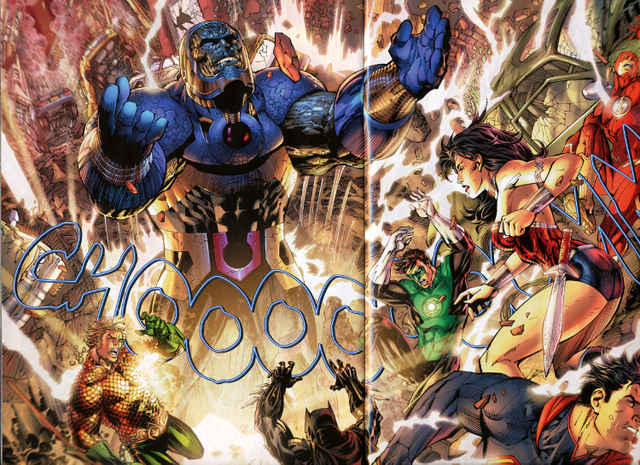 And then everyone stabbed him in the eye a bunch of times and Darksied sorta wandered off.The heroes decided to form a club based around their mutual interest in being insufferable ass-cocks and became the Justice League.
Then nothing happens for five years book-time until David Graves shows up so Geoff Johns can indulge in his favourite of all his writing tics: Being A Hero Means Being Fucking Miserable All The Fucking Time. Like Chris Claremont's obsession with mind control and making sure every female character's arc is a word-for-word retelling of The Story Of O, this was OK the first maybe . . .six times he did it, and now it has become his go-to storytelling device. And it's good that he has this to fall back on, as he's willingly ignoring everything he ever knew about writing compelling characters or plotting things with any kind of coherence.
He also managed to take 12-ish issues of Jim Lee art and completely strip the advantages of it's dynamism overcoming the shortcomings of the story because God knows all that action might get in the way of page after page of people looking sad all the fucking time.
Anyways, David Graves shows up and makes all the heroes sad because they failed to save his family and he made a deal with the Ashuras and . . .man, I'm not really sure what was going on in that story and certainly, reading the book was no help there. As with all Justice League storylines (including this one) it kind of pisses itself away, bored with itself. At the end of it, Steve Trevor gets kicked to the curb by Wonder Woman so Wonder Woman can play kissy-face with Superman.
That thread gets picked up in issue #13 and let me tell you: The "romance" between Superman and Wonder Woman makes Anakin and Padme's "romance" look like the kitchen scene in 9 1/2 Weeks, bled as it is of natural dialogue, genuine emotion, or even any kind of behaviour that reads as remotely human. I was forced to ask, reading those scenes: had Geoff Johns ever talked to another human being before? Has he just lived in this isolated bubble and in his loneliness he invented "friends" like Sammy the Apple, and Bill the Paper Towel Roll and they all grew up together and he imagines people talk in the same way his friends talked because he never got to go outside and learn anything else, and it's . . .it's kind of appalling, but also kind of sad, too.
But before we inflict a bunch of bleeding puncture wounds on the Superman/Wonder Woman romance, let's talk about the meat of this two-issue storyline (that feels like six, only you're missing three of them.) Because in THIS exciting story the Justice League gets into furry porn!
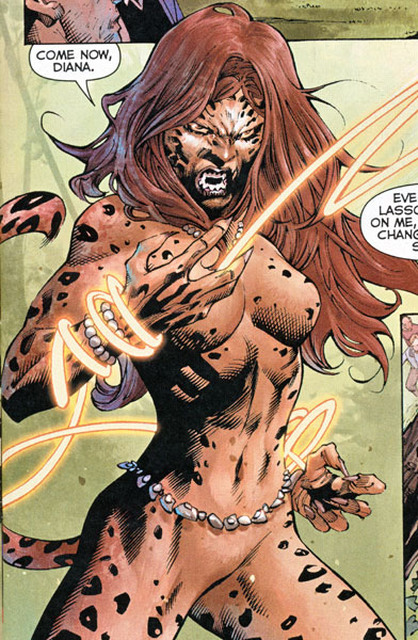
Yes, Wonder Woman is tussling with the Cheetah, and because JL is not a book that follows the "show don't tell" paradigm, we have to learn all the shit we should have known later. The Cheetah, Barbara Minerva is a woman whogot an FA account was Wonder Woman's first friend in the outside world, unfortunately, while puttering around the Congo she found a knife that was cursed (as well as being made on an entirely different continent besides Africa) and became the Cheetah.
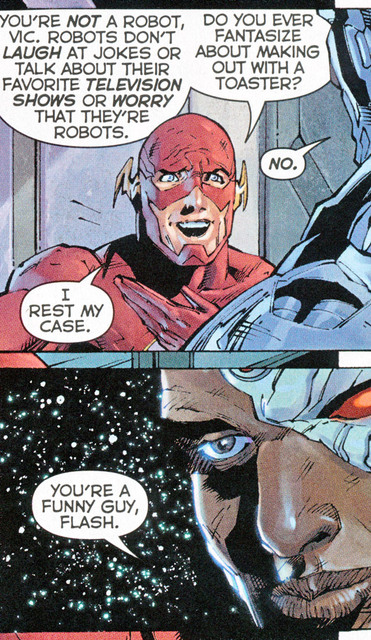
Oh, and 13 issues in, Cyborg actually gets featured and strained attempts to characteristic him as something other than the black guy the tech guy ensues. Cyborg says he sometimes thinks he's a machine that thinks he's the man he used to be.
Silly Cyborg--everyone on this team is a goddamned robot.
Issue #13 ends with the thrilling cliffhanger that the Cheetah has bit Superman and turned him into Super-Cheetah-Man and I'll spoil it now--the problem is so hastily brushed aside next issue, you'll feel like an idiot for even caring about it in the first place. Not that you did--that would require knowing more about Superman as a character you invested in emotionally. To you, Geoff Johns says, "eat my ass."
Before I can move on to the second issue and speed this suffering along, let's have a brief glimpse at the backup tale this issue. Previously in this space, Geoff Johns had been working diligently to make me care even less about Shazam than I had previously and from there, hate the entire world for creating such a bleak, nihilistic story featuring an utterly unlikeable little shit of a hero surrounded by a cast of jerkwads, and opposed by assholes. But more on that in a bit.
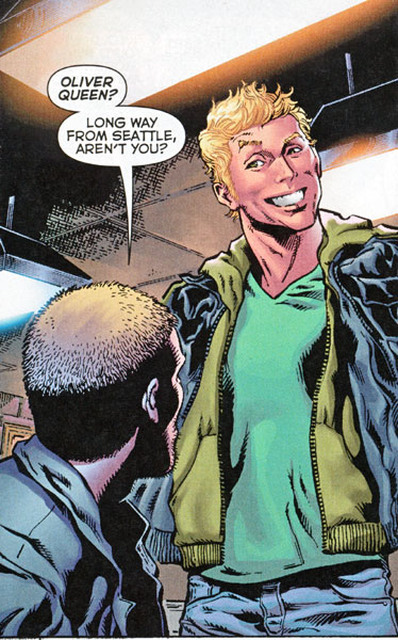
This issue trails Justice League of America #1, in which, it is assumed, Steve Trevor, fresh off of being cockblocked by Wonder Woman decides to fuck off and make his OWN Justice League, with blackjack! and hookers! And this shitweasel:
Now, in a different book, one that perhaps dealt with such things as "excitement" or "interest," this back-up story might tease the actual team, and whet one's appetite for seeing the team in their own book. To those people, Geoff John's says, "fuck your wants."
This is six pages of grumpy people taking meetings and sitting in bars and apparently DC has their own ersatz version of S.H.I.E.L.D. now, running things behind the scenes.
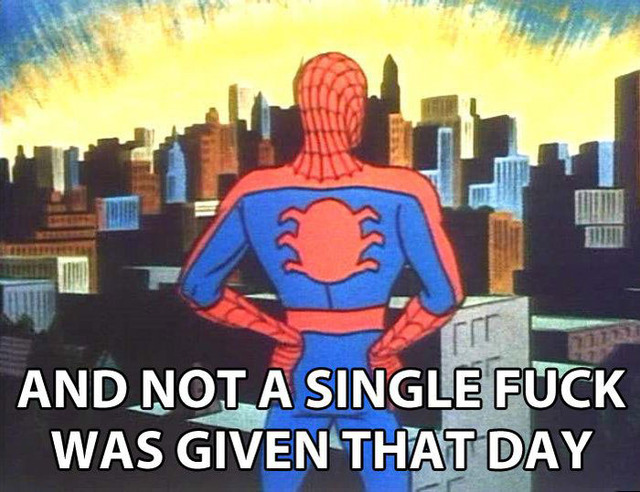
How do I feel about this plot development?
Thank God, Issue #14. The end of my agony is in sight. Anyways, back to the story,it's not hard to find/ ninja's not just of the body/but of the mind Cheetah-Superman is kicking the ass of the Justice League on the first page, when the lost tribe that created the Cheetah curse shows up, lest a sustained action sequence break out or anything:
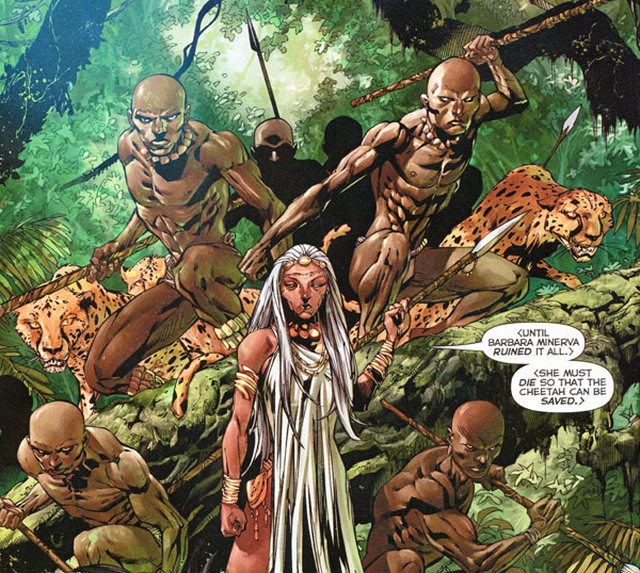
Speaking of sartorial changes, the Cheetah is also wearing a loincloth now because her absence of bits was freaking everyone out.
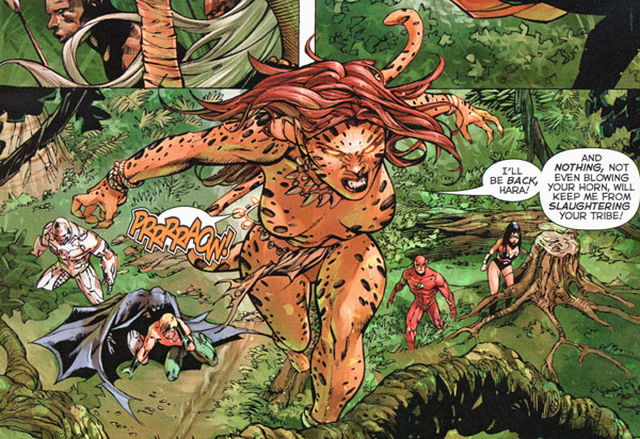
Cyborg manages to incapacitate Superman while Not-Storm from the Whogivesashit Tribe of the Outer Congo magics off the Cheetah VD or whatever the hell Superman has and Wonder Woman punches the Cheetah very hard and Aquaman tries to drown her. Ho ho ho, I tell you what, this Justice League, they really ARE the world's greatest heroes.
This is all a set-up for another of Geoff Johns pet tropes: the idea that Not Everyone Be Saved, Because People Are Basically Shits. You see, apparently, despite being a crippling condition that turns one into a sexy Thundercat, the Cheetah was once the tribe's goddess of the hunt, but then Barbara Minerva came along, and was such a greedy bitch that she's now turned the Cheetah into a bloodythirsty monster.
Because hunting and killing is totally OK otherwise, until you get too far into it and then you fuck it up for everyone. Lordy, Geoff Johns loves his irredeemable shitheels.
There's also a suggestion that getting captured was part of the Cheetah's plan to get captured, which . . .yeah, like it's that hard to put one over on the Justice League. But anyways, Wonder Woman gets all mopey because Barbara wasn't really her friend and maybe she's right and everyone's not worth shit, and Superman comes along says "there there, none of that" and takes her to Middle America Stereotype Cafe so they can have breakfast and he can show her that this wonderful (and 95% white) world is worth protecting and it's full of good people, kind people,white people, real down-to Earth people.
"It's just that simple," Superman says, in the very way that people don't and never have or will do, which leads into this stirring moment:
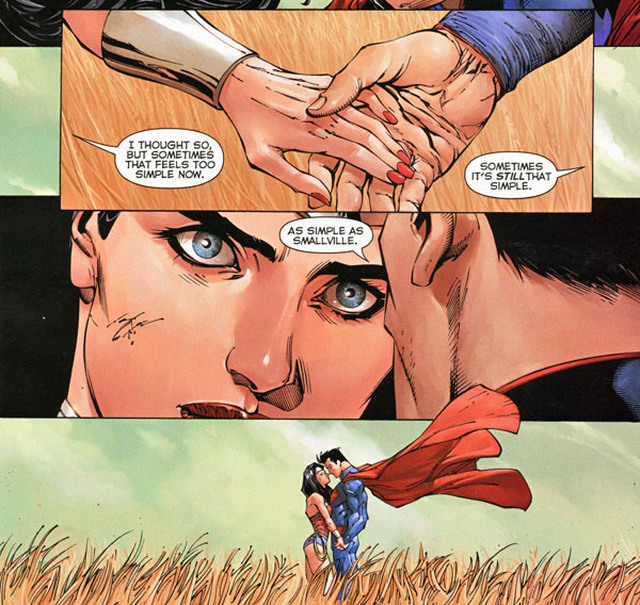
Anyways, they do a lot of (mercifully dialogue-free) smoochy-smoochy in the amber waves of grain and Batman is watching and scowling on a computer, because he can't fap to that.
Later, Wonder Woman writes a letter to Princess Celestia, in which she explains that she didn't learn a damn thing about friendship or anything like that, but does add that she didn't get the point of the Cheetah wearing a loincloth if the damn thing's flapping around in the breeze all the time. Thus is Wonder Woman barred by judicial restraining order from entering Equestria. Best thing for all concerned, really.
You may notice that I left artist Tony Daniel out of the line of fire in this scathing invective. It's for a very obvious reason: if Jim Lee couldn't make this shit work on the page, no one can, and Daniel does what he can with it, but it just kinda sits there, and isn't very exciting at all. In the olden Image days, artists could overcome weak scripts by being dynamic enough to at least make the book look cool enough that one didn't dwell overmuch on the fact that the plotting was mud-puddle shallow. Not given such opportunities here, he did the best he could.
It's Johns who shoulders most of the blame for this shambolic mess. First of all, injecting a best friend we never heard of just so she could go bad and make Wonder Woman sad is a stupid hacky trick that I recognised was a stupid hacky trick when they did it in Knight Rider (or was that Street Hawk?) and he should fucking well know better. For another, reducing the role of heroes to treating their role as protectors of the earth the way one might cope with being handed a shit sandwich because it always sucks and people aren't worth putting yourself out for anyways boils the books struggle down to dickheads fighting jackoffs about bullshit, and nothing anything.
But maybe that's the point. Maybe this is some sort of Dadaist detournment experiment, where we're just supposed to break though our preconceived notions and recognise it for the absurdity it is--that indeed, all human endeavour is. Maybe Justice League is a vehicle to expand our collective consciousness and accept that life is fleeting, truth meaningless, and humans ultimately impotent, ad we cling to the skein of a planet spinning out of control into the infinite darkness and only through embracing life's bleak meaninglessness can we truly live.
Anyways, let me wrap this up briefly by addressing the brutally pointless yet interminable Shazam! back-up in this issue. I'm not one of those people who whinges on about how Captain Marvel works best when it hews to its classic paradigm . . .I don't really care, actually. They weren't publishing it when I read comics early on, so a vital connection was never forged. All I know, is by and large, in my lifetime, Captain Marvel/Shazam/Photon/Whatever has been in a lot of shitty comics.
Shazan is mercifully fourteen pages of a shitty comic, featuring hateful characters doing mean shit to each other. Black Adam and Sivana show up looking for the Wizard Shazam, who's already given Hateful Shit #5, Billy Batson the power of Shazam, who is Shazaming it away on Shazam like a coat, which is also named Shazam, because I'm getting mighty god damned tired of typing the word "Shazam."
Black Adam throws some guy out of a window because Geoff Johns would break into each and every one of your houses and ruin something you loved before your tear-stained eyes if he had but world enough and time. Black and Adam and Sivana recruit one of the Seven Deadly Sins, Sloth (Chunk is nowhere to be seen after their bitter break-up twelve years ago) Nothing much happens, and we are not lead to think anything interesting will happen any time soon. Join us in issue #15 when Sazam looks at things, Black Adam takes a shit in a Salvation Army kettle, and Sivana ponders the deeper meaning of Taco Tuesday. The new DC, ladies and gentleman: There's Nothing Interesting Us, Now.
God, this comic is a big thick brick of depressing. It somehow manages to break through being mediocre, past being bad, into this lower strata where everything is stupid and pointless and Before Watchmen sounded like a good idea. No attempt is made to make anything interesting, or even bad in an entertaining sort of way. It's done with all the craft, care, and attention to detail of a DMV clerk looking down the barrel of a three-day weekend and who couldn't be less present in the moment if they were quantum-locked.
I did not care for this book: I guess that is what I am saying.
I like to think, most days, I succeed in this.
Then I read comics like these two issues of Justice League, and I am compelled, to react thus:
Oh yeah--I'm ripping this damn thing apart.
Longtime readers (all three of you) will be familiar with my quibbles over Justice League, the anchor of the New52, a series which deliberately ignores every possible opportunity for characterization, tight plotting, action, or even a unity of time or coherent plotting and does whatever the monthly comic equivalent of laying there and rotting like a dead fish is.
First, a brief history of the Justice League's run this far. The Justice League, largely comprised of assholes (except for Wonder Woman, who is written as a lobotomite), fussed and feuded and got in pissing contests about who was in charge, then in issue 4 or whatever, Darkseid showed up, farted:
Then nothing happens for five years book-time until David Graves shows up so Geoff Johns can indulge in his favourite of all his writing tics: Being A Hero Means Being Fucking Miserable All The Fucking Time. Like Chris Claremont's obsession with mind control and making sure every female character's arc is a word-for-word retelling of The Story Of O, this was OK the first maybe . . .six times he did it, and now it has become his go-to storytelling device. And it's good that he has this to fall back on, as he's willingly ignoring everything he ever knew about writing compelling characters or plotting things with any kind of coherence.
He also managed to take 12-ish issues of Jim Lee art and completely strip the advantages of it's dynamism overcoming the shortcomings of the story because God knows all that action might get in the way of page after page of people looking sad all the fucking time.
Anyways, David Graves shows up and makes all the heroes sad because they failed to save his family and he made a deal with the Ashuras and . . .man, I'm not really sure what was going on in that story and certainly, reading the book was no help there. As with all Justice League storylines (including this one) it kind of pisses itself away, bored with itself. At the end of it, Steve Trevor gets kicked to the curb by Wonder Woman so Wonder Woman can play kissy-face with Superman.
That thread gets picked up in issue #13 and let me tell you: The "romance" between Superman and Wonder Woman makes Anakin and Padme's "romance" look like the kitchen scene in 9 1/2 Weeks, bled as it is of natural dialogue, genuine emotion, or even any kind of behaviour that reads as remotely human. I was forced to ask, reading those scenes: had Geoff Johns ever talked to another human being before? Has he just lived in this isolated bubble and in his loneliness he invented "friends" like Sammy the Apple, and Bill the Paper Towel Roll and they all grew up together and he imagines people talk in the same way his friends talked because he never got to go outside and learn anything else, and it's . . .it's kind of appalling, but also kind of sad, too.
But before we inflict a bunch of bleeding puncture wounds on the Superman/Wonder Woman romance, let's talk about the meat of this two-issue storyline (that feels like six, only you're missing three of them.) Because in THIS exciting story the Justice League gets into furry porn!
Not pictured--mammalian characteristics. Also not pictured: dignity
Yes, Wonder Woman is tussling with the Cheetah, and because JL is not a book that follows the "show don't tell" paradigm, we have to learn all the shit we should have known later. The Cheetah, Barbara Minerva is a woman who
Oh, and 13 issues in, Cyborg actually gets featured and strained attempts to characteristic him as something other than
Silly Cyborg--everyone on this team is a goddamned robot.
No he isn't, Cyborg. Don't LIE
Issue #13 ends with the thrilling cliffhanger that the Cheetah has bit Superman and turned him into Super-Cheetah-Man and I'll spoil it now--the problem is so hastily brushed aside next issue, you'll feel like an idiot for even caring about it in the first place. Not that you did--that would require knowing more about Superman as a character you invested in emotionally. To you, Geoff Johns says, "eat my ass."
Before I can move on to the second issue and speed this suffering along, let's have a brief glimpse at the backup tale this issue. Previously in this space, Geoff Johns had been working diligently to make me care even less about Shazam than I had previously and from there, hate the entire world for creating such a bleak, nihilistic story featuring an utterly unlikeable little shit of a hero surrounded by a cast of jerkwads, and opposed by assholes. But more on that in a bit.
This issue trails Justice League of America #1, in which, it is assumed, Steve Trevor, fresh off of being cockblocked by Wonder Woman decides to fuck off and make his OWN Justice League, with blackjack! and hookers! And this shitweasel:
And the winner of 2012's award for Most Punchable Face goes to . . .
Now, in a different book, one that perhaps dealt with such things as "excitement" or "interest," this back-up story might tease the actual team, and whet one's appetite for seeing the team in their own book. To those people, Geoff John's says, "fuck your wants."
This is six pages of grumpy people taking meetings and sitting in bars and apparently DC has their own ersatz version of S.H.I.E.L.D. now, running things behind the scenes.
How do I feel about this plot development?
Oh, right.
Thank God, Issue #14. The end of my agony is in sight. Anyways, back to the story,
You know she's in charge because she's wearing the ONE bedsheet the tribe has.
Speaking of sartorial changes, the Cheetah is also wearing a loincloth now because her absence of bits was freaking everyone out.
For reasons I don't know, whenever the loincloth is drawn for the rest of the issue, it's drawn at that angle. EVERY TIME. Even when Aquaman tries to drown her.
Cyborg manages to incapacitate Superman while Not-Storm from the Whogivesashit Tribe of the Outer Congo magics off the Cheetah VD or whatever the hell Superman has and Wonder Woman punches the Cheetah very hard and Aquaman tries to drown her. Ho ho ho, I tell you what, this Justice League, they really ARE the world's greatest heroes.
This is all a set-up for another of Geoff Johns pet tropes: the idea that Not Everyone Be Saved, Because People Are Basically Shits. You see, apparently, despite being a crippling condition that turns one into a sexy Thundercat, the Cheetah was once the tribe's goddess of the hunt, but then Barbara Minerva came along, and was such a greedy bitch that she's now turned the Cheetah into a bloodythirsty monster.
Because hunting and killing is totally OK otherwise, until you get too far into it and then you fuck it up for everyone. Lordy, Geoff Johns loves his irredeemable shitheels.
There's also a suggestion that getting captured was part of the Cheetah's plan to get captured, which . . .yeah, like it's that hard to put one over on the Justice League. But anyways, Wonder Woman gets all mopey because Barbara wasn't really her friend and maybe she's right and everyone's not worth shit, and Superman comes along says "there there, none of that" and takes her to Middle America Stereotype Cafe so they can have breakfast and he can show her that this wonderful (and 95% white) world is worth protecting and it's full of good people, kind people,
"It's just that simple," Superman says, in the very way that people don't and never have or will do, which leads into this stirring moment:
Everything's "just that simple" when you're a simpleton!
Anyways, they do a lot of (mercifully dialogue-free) smoochy-smoochy in the amber waves of grain and Batman is watching and scowling on a computer, because he can't fap to that.
Later, Wonder Woman writes a letter to Princess Celestia, in which she explains that she didn't learn a damn thing about friendship or anything like that, but does add that she didn't get the point of the Cheetah wearing a loincloth if the damn thing's flapping around in the breeze all the time. Thus is Wonder Woman barred by judicial restraining order from entering Equestria. Best thing for all concerned, really.
You may notice that I left artist Tony Daniel out of the line of fire in this scathing invective. It's for a very obvious reason: if Jim Lee couldn't make this shit work on the page, no one can, and Daniel does what he can with it, but it just kinda sits there, and isn't very exciting at all. In the olden Image days, artists could overcome weak scripts by being dynamic enough to at least make the book look cool enough that one didn't dwell overmuch on the fact that the plotting was mud-puddle shallow. Not given such opportunities here, he did the best he could.
It's Johns who shoulders most of the blame for this shambolic mess. First of all, injecting a best friend we never heard of just so she could go bad and make Wonder Woman sad is a stupid hacky trick that I recognised was a stupid hacky trick when they did it in Knight Rider (or was that Street Hawk?) and he should fucking well know better. For another, reducing the role of heroes to treating their role as protectors of the earth the way one might cope with being handed a shit sandwich because it always sucks and people aren't worth putting yourself out for anyways boils the books struggle down to dickheads fighting jackoffs about bullshit, and nothing anything.
But maybe that's the point. Maybe this is some sort of Dadaist detournment experiment, where we're just supposed to break though our preconceived notions and recognise it for the absurdity it is--that indeed, all human endeavour is. Maybe Justice League is a vehicle to expand our collective consciousness and accept that life is fleeting, truth meaningless, and humans ultimately impotent, ad we cling to the skein of a planet spinning out of control into the infinite darkness and only through embracing life's bleak meaninglessness can we truly live.
I'm kidding--this comic can go fuck itself.
Anyways, let me wrap this up briefly by addressing the brutally pointless yet interminable Shazam! back-up in this issue. I'm not one of those people who whinges on about how Captain Marvel works best when it hews to its classic paradigm . . .I don't really care, actually. They weren't publishing it when I read comics early on, so a vital connection was never forged. All I know, is by and large, in my lifetime, Captain Marvel/Shazam/Photon/Whatever has been in a lot of shitty comics.
Shazan is mercifully fourteen pages of a shitty comic, featuring hateful characters doing mean shit to each other. Black Adam and Sivana show up looking for the Wizard Shazam, who's already given Hateful Shit #5, Billy Batson the power of Shazam, who is Shazaming it away on Shazam like a coat, which is also named Shazam, because I'm getting mighty god damned tired of typing the word "Shazam."
Black Adam throws some guy out of a window because Geoff Johns would break into each and every one of your houses and ruin something you loved before your tear-stained eyes if he had but world enough and time. Black and Adam and Sivana recruit one of the Seven Deadly Sins, Sloth (Chunk is nowhere to be seen after their bitter break-up twelve years ago) Nothing much happens, and we are not lead to think anything interesting will happen any time soon. Join us in issue #15 when Sazam looks at things, Black Adam takes a shit in a Salvation Army kettle, and Sivana ponders the deeper meaning of Taco Tuesday. The new DC, ladies and gentleman: There's Nothing Interesting Us, Now.
God, this comic is a big thick brick of depressing. It somehow manages to break through being mediocre, past being bad, into this lower strata where everything is stupid and pointless and Before Watchmen sounded like a good idea. No attempt is made to make anything interesting, or even bad in an entertaining sort of way. It's done with all the craft, care, and attention to detail of a DMV clerk looking down the barrel of a three-day weekend and who couldn't be less present in the moment if they were quantum-locked.
I did not care for this book: I guess that is what I am saying.
Friday, December 7, 2012
Just Sayin'--Seasonal Affective Backlog
Well, I guess I let this lie longer than I thought. Once again, 'tis I, I'm back and I had two months worth of comics come in this week, so it's high time to look 'em over and see what's what.
All except Justice League #13-14. They were a special kind of terrible that must be handled in its own very special. Really. Just . . .awful.
Anyways--let's get down to it!
HARBINGER #5-6: So we're getting more into the classic mode of Harbinger storytelling, as Pete Stanchek finally escapes from Harada and strikes out on his own. Out of a window.
But before he can get too far, he's interrupted from his suicidal FU by Zephyr, and man, did I ever miss characters like Zephyr. As she was in the OG version, she's quite into the idea of being superpowered, which is good, because in this version a little leavening of the angst is always good (not that I'm complaining--one of the the things I'm enjoying about the new Harbinger is that it makes no bones about the idea that Stanchek is potentially just as bad as Harada actually is at the moment) and . . .
. . .given that in the very next issue things are heating up plot-wise, that's a good thing. Issue #6 brings us back to Kris Hathaway, who you might remember Stanchek mind-controlling into loving him (remember how I said he was potentially a shitheel? Crap like this is why) in the original book, Kris was the glue that held the team together (in ways both overt and covert, but no reason to be beholden to comics more than twenty years old now) In the new version, Stanchek, guilty about manipulating her, offers to let her kill him.
Kris sees right through it, of course--he's giving her permission, and that's bullshit. It's a good scene, and Dysart really does well with the implications of everything, and as much as I like Zephyr, I really came around to Kris this issue. While, yeah, it took them six issues to get where the original got at by issue four, I don't mind decompression if you use it like this: wherein a character in the story encapsulates what the book is really about: who has power, how do they use it, and what about the people who get caught up in their wake.
I'm really enjoying this book.
GLORY #29-30 Speaking of books I enjoy (gonna be sad when this one finishes soon) Glory's quest to deal with her father enters its final act, but before then, she's got to swing by Paris to enlist her sister, Nanaja, who curses up a storm and, it must be said, is more than a bit murder-happy. That works OK for this book, as it's an excuse for Ross Campbell to draw some ultra-violence (in addition to drawing woman who are built like brick shithouses, Campbell does a phenomenal job of drawing impacts--you can feel and see the heft and effect of every punch thrown) which, bless him he does so very well indeed.
I enjoyed the little Fantomas bit at the opening of Issue #30--it was a good palate cleanser before the Glory/Nanaja fight, and made for a fun little contrast as well. I quite enjoyed these two issues, and I'm intrigued to see how it comes along as we go through the home stretch.
PROPHET #30-31: I wonder if Rob Liefeld is impressed that his Captain America/Iron Man analogue, Diehard is being used in the entertainingly bizarre way he is in these stories. As much as I appreciate the bizarre imagery that's all over these two issues, I think I appreciate the meditative pace even more, as it makes the surreal images that saturate this book even more dreamlike. I have no notion of where it's going, but it's to Brandon Graham's credit that I am really enjoying the journey.
CYBERFORCE #1: Well, it was free, so there's that. I've always had a strange affection for Cyberforce, one of the vanguard of the early Image books, back when superhero comic's top-flight creators all simultaneously decided to create knockoffs of the X-Men and publish them for the purposes of making lots of monies (I kid, I kid) partly because I was at the ideal age to get fired up by those comics, and partly because this is the book that introduced the man, the myth, the legend--WARBUK to a world that had been waiting for him all their collective lives.
Cyberforce, you might remember, was resurrected as a free comic thanks to a successful Kickstarter campaign, and apparently, I'm not alone in my love for the comic.
Unfortunately . . .this is kinda not good. It's confusing, enervating, hatefully opaque with regards to the plot, and doesn't really intrigue me enough to think about reading more. There's none of the ferocious energy and slick action that characterized the original book, and it's not like Prophet or Glory where there's a sufficiently imaginative take on the material to offset that, and I can't really pick out any character apart from maybe three (Velocity, Ballistic, and Aphrodite IX)
And also. . .no WARBUK.
I think you could launch Cyberforce again in a way that would really grip one's shit, but I'm not really sure this is the way to do it.Nice to see it back for the 20th anniversary of Image tho, I reckon.
BATWOMAN #13-14: Now how do I review this? It looks beautiful, oh my God does it ever look gorgeous. I love that J.H. Williams III is able to do these ornate spreads that are visually striking and still move the story along.
I do, however, wish the story in question was actually interesting and hadn't been plodding along, to one extent or another in near-perfect stasis, for the past ten issues now. While I appreciate that Wonder Woman's teaming up with Batwoman (and thus giving Batwoman some legitimacy and integrating her with the DCU independent of the Batman family), and the Flamebird plot is moving forward (slowly, my God how slowly) and the various other subplots are ticking over, I find myself intensely frustrated because it's been ten fucking issues and we're just now seeing Medusa and I kind of just want it all to be over now and move on to something else that doesn't run so long and get so baroque that I don't care anymore.
So that's my comic haul. Join us next time when I rip into Justice League #13-14, featuring furry porn, every Geoff Johns tic I can't stand, plotting so static it could be late-model Claremont at his deadly worst, female characters that make the cast of Tarot seem enlightened, romance so lifeless it might as well be necrophilia, and more of the utterly god-awful "Shazam" story. If you missed the days when I would rip shit out of a comic I bitterly loathed, well, that time is now again.
All except Justice League #13-14. They were a special kind of terrible that must be handled in its own very special. Really. Just . . .awful.
Anyways--let's get down to it!
HARBINGER #5-6: So we're getting more into the classic mode of Harbinger storytelling, as Pete Stanchek finally escapes from Harada and strikes out on his own. Out of a window.
But before he can get too far, he's interrupted from his suicidal FU by Zephyr, and man, did I ever miss characters like Zephyr. As she was in the OG version, she's quite into the idea of being superpowered, which is good, because in this version a little leavening of the angst is always good (not that I'm complaining--one of the the things I'm enjoying about the new Harbinger is that it makes no bones about the idea that Stanchek is potentially just as bad as Harada actually is at the moment) and . . .
. . .given that in the very next issue things are heating up plot-wise, that's a good thing. Issue #6 brings us back to Kris Hathaway, who you might remember Stanchek mind-controlling into loving him (remember how I said he was potentially a shitheel? Crap like this is why) in the original book, Kris was the glue that held the team together (in ways both overt and covert, but no reason to be beholden to comics more than twenty years old now) In the new version, Stanchek, guilty about manipulating her, offers to let her kill him.
Kris sees right through it, of course--he's giving her permission, and that's bullshit. It's a good scene, and Dysart really does well with the implications of everything, and as much as I like Zephyr, I really came around to Kris this issue. While, yeah, it took them six issues to get where the original got at by issue four, I don't mind decompression if you use it like this: wherein a character in the story encapsulates what the book is really about: who has power, how do they use it, and what about the people who get caught up in their wake.
I'm really enjoying this book.
GLORY #29-30 Speaking of books I enjoy (gonna be sad when this one finishes soon) Glory's quest to deal with her father enters its final act, but before then, she's got to swing by Paris to enlist her sister, Nanaja, who curses up a storm and, it must be said, is more than a bit murder-happy. That works OK for this book, as it's an excuse for Ross Campbell to draw some ultra-violence (in addition to drawing woman who are built like brick shithouses, Campbell does a phenomenal job of drawing impacts--you can feel and see the heft and effect of every punch thrown) which, bless him he does so very well indeed.
I enjoyed the little Fantomas bit at the opening of Issue #30--it was a good palate cleanser before the Glory/Nanaja fight, and made for a fun little contrast as well. I quite enjoyed these two issues, and I'm intrigued to see how it comes along as we go through the home stretch.
PROPHET #30-31: I wonder if Rob Liefeld is impressed that his Captain America/Iron Man analogue, Diehard is being used in the entertainingly bizarre way he is in these stories. As much as I appreciate the bizarre imagery that's all over these two issues, I think I appreciate the meditative pace even more, as it makes the surreal images that saturate this book even more dreamlike. I have no notion of where it's going, but it's to Brandon Graham's credit that I am really enjoying the journey.
CYBERFORCE #1: Well, it was free, so there's that. I've always had a strange affection for Cyberforce, one of the vanguard of the early Image books, back when superhero comic's top-flight creators all simultaneously decided to create knockoffs of the X-Men and publish them for the purposes of making lots of monies (I kid, I kid) partly because I was at the ideal age to get fired up by those comics, and partly because this is the book that introduced the man, the myth, the legend--WARBUK to a world that had been waiting for him all their collective lives.
Cyberforce, you might remember, was resurrected as a free comic thanks to a successful Kickstarter campaign, and apparently, I'm not alone in my love for the comic.
Unfortunately . . .this is kinda not good. It's confusing, enervating, hatefully opaque with regards to the plot, and doesn't really intrigue me enough to think about reading more. There's none of the ferocious energy and slick action that characterized the original book, and it's not like Prophet or Glory where there's a sufficiently imaginative take on the material to offset that, and I can't really pick out any character apart from maybe three (Velocity, Ballistic, and Aphrodite IX)
And also. . .no WARBUK.
I think you could launch Cyberforce again in a way that would really grip one's shit, but I'm not really sure this is the way to do it.Nice to see it back for the 20th anniversary of Image tho, I reckon.
BATWOMAN #13-14: Now how do I review this? It looks beautiful, oh my God does it ever look gorgeous. I love that J.H. Williams III is able to do these ornate spreads that are visually striking and still move the story along.
I do, however, wish the story in question was actually interesting and hadn't been plodding along, to one extent or another in near-perfect stasis, for the past ten issues now. While I appreciate that Wonder Woman's teaming up with Batwoman (and thus giving Batwoman some legitimacy and integrating her with the DCU independent of the Batman family), and the Flamebird plot is moving forward (slowly, my God how slowly) and the various other subplots are ticking over, I find myself intensely frustrated because it's been ten fucking issues and we're just now seeing Medusa and I kind of just want it all to be over now and move on to something else that doesn't run so long and get so baroque that I don't care anymore.
So that's my comic haul. Join us next time when I rip into Justice League #13-14, featuring furry porn, every Geoff Johns tic I can't stand, plotting so static it could be late-model Claremont at his deadly worst, female characters that make the cast of Tarot seem enlightened, romance so lifeless it might as well be necrophilia, and more of the utterly god-awful "Shazam" story. If you missed the days when I would rip shit out of a comic I bitterly loathed, well, that time is now again.
Thursday, November 15, 2012
I Read This--THUNDERBOLTS CLASSIC Vol. 3
How do I know that Thunderbolts was one of the last times Marvel's created a brand? Because they've re-launched the book so many times in so many ways far from the initial remit that it's now just a title that has some catchet, but people probably don't remember why exactly.
Which is what I guess these reprints are for (though why you'd want to remind people what they never knew the title was because they came in later is hard to fathom). When last we passed this way, I covered Volumes 1 and 2 of Thunderbolts, taking us up and over it's first year of publication, and past the Big Surprise Twist that anchored the first year of the book. Volume 3 takes us into year 2, and the book's other, major-but-not-quite-as-earth-shaking status quo change and keeps its various subplots ticking over.
After the three-parter in Kosmos, the Thunderbolts return to Earth and try to make a go of going straight. Unfortunately, they're pretty crappy at it, as Zemo and S.H.I.E.L.D. immediately twig on to the fact that they're back and start hunting them down. (Well, S.H.I.E.L.D. more than Zemo at first) It's. . .well, it's fall-out from the first year on the book, and really exists more as a backdrop for the real story--the Thunderbolts are on the point of breaking up, as Jolt's trying to be the positive cheerleader, Moonstone is manipulating everyone so she can be in charge, Songbird's falling back into her pro-wrestling persona (though this does give us some awesome wrestling references) MACH-1 is trying to figure out what's wrong with Songbird and Atlas is mopey because he's feeling like he's a danger to himself and others.
So they fight S.H.I.E.L.D. in issue #15, and in issue #16 fight the Great Lakes Avengers (and. . .honestly, while I appreciate that some people find the GLA funny, all I see is John Byrne's strained attempts at superhero parody and then, despair) who hitched their wagon to the Thunderbolts, only to find when they were outed, everyone assumed that they were criminals too (they aren't--they're just stupid) Even being fractious and not on the same page, the Thunderbolts beat the GLA, as you'd expect (then again, a dead Thalidomide baby on a string swung with sufficient force could defeat the Great Lakes Avengers) and then they go on to fight a Hulk robot sent by Zemo.
The Hulk robot is just a sideshow, that somehow brings Graviton (note: not the Gravitron--that's a fair ride) and this leads to a mildly interesting three-way dance between the Great Lakes Avengers (who apparently can't leave me alone) livened up by a parallel plot wherein Zemo is attacked by . . .Citizen V. The mystery of who Citizen V is get strung out a little more than it needs to be (friend of the Prattle Chris Elam got a letter published in Thunderbolts that had basically figured it out a few issues before the proverbial penny dropped) There's a good bit where Moonstone gets rid of Graviton by pointing out that despite his godlike power, he really has no game plan for it, and that's why he fails. Amazingly it works, even if it is really short-term thinking. They also get the Great Lakes Avengers to finally leave the damn book, but no psychological jiu-jitsu was involved there.
Issue #18 is the buildup to the major status-quo change I mentioned earlier, as the stress fractures on the Thunderbolts are brought to a head just as the Masters of Evil (from way back in issue #3) return to the book. After the contractually-mandated fight between the teams, the Masters' leader, Crimson Cowl, invites the Thunderbolts to join the Masters, and given the loose end the team finds themselves in, they're actually considering it.
But to string that decision out a bit longer, we have a detour to honour a contractual agreement and roll out the winner of the Wizard magazine create-a-character contest: Charcoal: the Burning Man (not to be confused with Burning Man, obviously) Charcoal is an operative of the Imperial Forces (who eventually turn out to be a gestalt of a lot of barely-remembered Captain America villains like the Secret Empire and the Loyalist Forces of America, which is continuity-obsession bordering on the rabbinical) and the whole thing looks like it's going the Thunderbolts' way, except the Masters show up at the end and tell them they don't get to play hero while they're thinking it over.
But they're not gonna have long to keep beating that drum, as in the very next issue, the Thunderbolts decide that they won't be dictated to, and take the fight to the Masters, which doesn't go well for the Thunderbolts until; Dreadknight ("Who? Exactly.") to rescue the Thunderbolts, only it turns out it's actually Hawkeye, thus beginning, more or less, the era of Hawkeye leading the Thunderbolts.
This also means, as I mentioned in the Marvel Universe reviews a few years back, that Dreadknight has shown up as someone's cover identity way more than he has as a character.In the Marvel Universe, Dreadknight must be the equivalent of a french maid's outfit or a sexy nurse costume--it's the go-to choice.
I'm of two minds about it, really. I can see the logic of it--Hawkeye was the first Marvel villain to go straight (right? Mr. Busiek, feel free to correct me if I'm wrong.) and as such, is a natural exemplar of the paradigm the Thunderbolts are aiming towards, and Busiek works really hard to make sure that it's not as simple as Hawkeye showing up and hey presto, the Thunderbolts have legitimacy--if anything, getting involved with them compromises him. So it kinda works.
But . . .and I say this as someone who read far too many West Coast Avengers books than is healthy for a human being to read--Hawkeye is not terribly interesting in the role of leader, at least for me. Of course, you can't keep him in the role of Avengers pain in the ass indefinitely either, but in general, when you make him a leader, it tends to blunt the "wildcard" edge of the character.
Anyways, Hawkeye fills the Thunderbolts' head with notions of being pardoned (which is all bullshit) and says that the one known murderer--MACH-1--has to go to jail (also, that someone actually read Deadly Foes of Spider-Man, and that someone is writing Thunderbolts. How 'bout that?) Meanwhile, Hercules shows up to pay Atlas back for beating the hell of him about ten years and change ago, and Hawkeye has to put himself on the line to keep Hercules from murdering Atlas, which is a good story and does tie Hawkeye in with the book's tension more than just making him Happy Smiling Leader Guy.
We take a break for a bit to catch up with the Zemo/Citzen V stuff in Captain America/Citizen V, which is a serviceable enough romp and a means to deliver some of Citzen V's backstory and how this one relates to the Golden Age hero of the same name. Oh, and Citizen V is actually a woman and has a whole team of people on call. These things will become important later, but . . .just sayin'.
We go from there to the Wizard mail-in Thunderbolts #0, which features a brief fight with HYDRA in between a clip-art "the story so far" recap, which sets up the first of the big Avengers/Thunderbolts crossovers (of which I think there ended up being exactly two and we've covered both of them now. . .this one from both sides) in Avengers #12, when the Thunderbolts and Avengers fight, then team up, then they team up and fight the utterly confusing Dominus, The Continuity Backwater That Walks Like A Giant Robot. Hawkeye declares his intention to help the Thunderbolts go straight and that's the end of the book.
Being a collection of an in-progress story, Volume 3 feels a bit jumbled--Hawkeye taking command is supposed to be a proper Big Moment, but it doesn't quite make it there in the end. Instead, it feels like there's a heavier story beat yet to drop (and there is, but that's around issue #24 with the next fight with the Masters) but it's not included in this lot, so the overall package feels a little . . .incomplete. Coupled with the fact that these are not the strongest issues (they're pretty much all transition and as such, a little thin) means this collection doesn't have the punch that the first two volumes had. However, if you can enjoy the welter of references and the long game Busiek is playing with the book, there's plenty you'll get out of it.
Which is what I guess these reprints are for (though why you'd want to remind people what they never knew the title was because they came in later is hard to fathom). When last we passed this way, I covered Volumes 1 and 2 of Thunderbolts, taking us up and over it's first year of publication, and past the Big Surprise Twist that anchored the first year of the book. Volume 3 takes us into year 2, and the book's other, major-but-not-quite-as-earth-shaking status quo change and keeps its various subplots ticking over.
After the three-parter in Kosmos, the Thunderbolts return to Earth and try to make a go of going straight. Unfortunately, they're pretty crappy at it, as Zemo and S.H.I.E.L.D. immediately twig on to the fact that they're back and start hunting them down. (Well, S.H.I.E.L.D. more than Zemo at first) It's. . .well, it's fall-out from the first year on the book, and really exists more as a backdrop for the real story--the Thunderbolts are on the point of breaking up, as Jolt's trying to be the positive cheerleader, Moonstone is manipulating everyone so she can be in charge, Songbird's falling back into her pro-wrestling persona (though this does give us some awesome wrestling references) MACH-1 is trying to figure out what's wrong with Songbird and Atlas is mopey because he's feeling like he's a danger to himself and others.
So they fight S.H.I.E.L.D. in issue #15, and in issue #16 fight the Great Lakes Avengers (and. . .honestly, while I appreciate that some people find the GLA funny, all I see is John Byrne's strained attempts at superhero parody and then, despair) who hitched their wagon to the Thunderbolts, only to find when they were outed, everyone assumed that they were criminals too (they aren't--they're just stupid) Even being fractious and not on the same page, the Thunderbolts beat the GLA, as you'd expect (then again, a dead Thalidomide baby on a string swung with sufficient force could defeat the Great Lakes Avengers) and then they go on to fight a Hulk robot sent by Zemo.
The Hulk robot is just a sideshow, that somehow brings Graviton (note: not the Gravitron--that's a fair ride) and this leads to a mildly interesting three-way dance between the Great Lakes Avengers (who apparently can't leave me alone) livened up by a parallel plot wherein Zemo is attacked by . . .Citizen V. The mystery of who Citizen V is get strung out a little more than it needs to be (friend of the Prattle Chris Elam got a letter published in Thunderbolts that had basically figured it out a few issues before the proverbial penny dropped) There's a good bit where Moonstone gets rid of Graviton by pointing out that despite his godlike power, he really has no game plan for it, and that's why he fails. Amazingly it works, even if it is really short-term thinking. They also get the Great Lakes Avengers to finally leave the damn book, but no psychological jiu-jitsu was involved there.
Issue #18 is the buildup to the major status-quo change I mentioned earlier, as the stress fractures on the Thunderbolts are brought to a head just as the Masters of Evil (from way back in issue #3) return to the book. After the contractually-mandated fight between the teams, the Masters' leader, Crimson Cowl, invites the Thunderbolts to join the Masters, and given the loose end the team finds themselves in, they're actually considering it.
But to string that decision out a bit longer, we have a detour to honour a contractual agreement and roll out the winner of the Wizard magazine create-a-character contest: Charcoal: the Burning Man (not to be confused with Burning Man, obviously) Charcoal is an operative of the Imperial Forces (who eventually turn out to be a gestalt of a lot of barely-remembered Captain America villains like the Secret Empire and the Loyalist Forces of America, which is continuity-obsession bordering on the rabbinical) and the whole thing looks like it's going the Thunderbolts' way, except the Masters show up at the end and tell them they don't get to play hero while they're thinking it over.
But they're not gonna have long to keep beating that drum, as in the very next issue, the Thunderbolts decide that they won't be dictated to, and take the fight to the Masters, which doesn't go well for the Thunderbolts until; Dreadknight ("Who? Exactly.") to rescue the Thunderbolts, only it turns out it's actually Hawkeye, thus beginning, more or less, the era of Hawkeye leading the Thunderbolts.
This also means, as I mentioned in the Marvel Universe reviews a few years back, that Dreadknight has shown up as someone's cover identity way more than he has as a character.In the Marvel Universe, Dreadknight must be the equivalent of a french maid's outfit or a sexy nurse costume--it's the go-to choice.
I'm of two minds about it, really. I can see the logic of it--Hawkeye was the first Marvel villain to go straight (right? Mr. Busiek, feel free to correct me if I'm wrong.) and as such, is a natural exemplar of the paradigm the Thunderbolts are aiming towards, and Busiek works really hard to make sure that it's not as simple as Hawkeye showing up and hey presto, the Thunderbolts have legitimacy--if anything, getting involved with them compromises him. So it kinda works.
But . . .and I say this as someone who read far too many West Coast Avengers books than is healthy for a human being to read--Hawkeye is not terribly interesting in the role of leader, at least for me. Of course, you can't keep him in the role of Avengers pain in the ass indefinitely either, but in general, when you make him a leader, it tends to blunt the "wildcard" edge of the character.
Anyways, Hawkeye fills the Thunderbolts' head with notions of being pardoned (which is all bullshit) and says that the one known murderer--MACH-1--has to go to jail (also, that someone actually read Deadly Foes of Spider-Man, and that someone is writing Thunderbolts. How 'bout that?) Meanwhile, Hercules shows up to pay Atlas back for beating the hell of him about ten years and change ago, and Hawkeye has to put himself on the line to keep Hercules from murdering Atlas, which is a good story and does tie Hawkeye in with the book's tension more than just making him Happy Smiling Leader Guy.
We take a break for a bit to catch up with the Zemo/Citzen V stuff in Captain America/Citizen V, which is a serviceable enough romp and a means to deliver some of Citzen V's backstory and how this one relates to the Golden Age hero of the same name. Oh, and Citizen V is actually a woman and has a whole team of people on call. These things will become important later, but . . .just sayin'.
We go from there to the Wizard mail-in Thunderbolts #0, which features a brief fight with HYDRA in between a clip-art "the story so far" recap, which sets up the first of the big Avengers/Thunderbolts crossovers (of which I think there ended up being exactly two and we've covered both of them now. . .this one from both sides) in Avengers #12, when the Thunderbolts and Avengers fight, then team up, then they team up and fight the utterly confusing Dominus, The Continuity Backwater That Walks Like A Giant Robot. Hawkeye declares his intention to help the Thunderbolts go straight and that's the end of the book.
Being a collection of an in-progress story, Volume 3 feels a bit jumbled--Hawkeye taking command is supposed to be a proper Big Moment, but it doesn't quite make it there in the end. Instead, it feels like there's a heavier story beat yet to drop (and there is, but that's around issue #24 with the next fight with the Masters) but it's not included in this lot, so the overall package feels a little . . .incomplete. Coupled with the fact that these are not the strongest issues (they're pretty much all transition and as such, a little thin) means this collection doesn't have the punch that the first two volumes had. However, if you can enjoy the welter of references and the long game Busiek is playing with the book, there's plenty you'll get out of it.
Sunday, November 11, 2012
I Read This--MARVEL COMICS: THE UNTOLD STORY
Per the suggestion of the estimable Colin Smith over at Too Busy Thinking About My Comics, I recently read this rather thick tome documenting the evolution of Marvel Comics from cash-in on a trend, to distaff cousin of a line of men's magazines, to a comic company of note, to corporate entity, to junk bond write-off, to bankruptcy, to its current status as Disney's latest--er, not anymore, I guess--IP farm.
And the (and this is a conservative estimate) 2,000 or so people who got screwed on the way there. The overriding take-away from this book is that corporate comics are everything that everyone demonizes them as, and so much worse. Time and again, people on the lowest rung of the ladder get crapped on, and then, when those who are crapped on get in positions of power, they get ground up and abandoned by the machine they'd been feeding.
Probably the main thread through all this is the story of Stan Lee, who runs through the book being an impetus for Marvel's initial growth, a flack for the company during a multitude of lawsuits by artists and writers trying to get some financial recompense (especially once everyone twigs that the real money is when the comics characters level-up into exploitable IPs) only to be hoisted up by his own petard when he's forced out from even his figurehead position and files suit for a slice of the pie himself.
Mind you, reading about the constant exploitation of the creative class and the circumlocutions meant to keep them from feeding at the trough can get a little draining, and dismaying if you hold creative aspirations yourself, but author Sean Howe covers quite a big swath of Marvel's history and depicts the players and positions ably.
Well, except for that bit near the end when everyone's trying to pull Marvel out of bankruptcy and force each other out--that gets a bit tangled up in the shadow play that is corporate wheeling and dealing. You won't get a huge run-down of Marvel's creative trumps (some lip-service is paid to the big ones) and some of the older scandals may sound like old hat if you've been reading a lot of fanzines, but there's some fresh bits I hadn't heard before, like the exact break-point when Grant Morrison finally had enough of marvel (and a startlingly accurate diagnosis of Bill Jemas by Tom Brevoort quite germane to that) and a few others bits of interest.
I found this to be an eminently readable book, and one I'm probably gonna re-read here soonish. If nothing else, it makes the perfect antipode for Les Daniels' Marvel: Five Fabulous Decades of The World's Greatest Comics on my bookshelf. Even if you have no interest in superhero comics, or corporate comics, or Marvel comics, it's still well worth a read, as it's a blueprint of the multitude of ways that creative types can easily get ground down if they're not careful. Highly recommended.
And the (and this is a conservative estimate) 2,000 or so people who got screwed on the way there. The overriding take-away from this book is that corporate comics are everything that everyone demonizes them as, and so much worse. Time and again, people on the lowest rung of the ladder get crapped on, and then, when those who are crapped on get in positions of power, they get ground up and abandoned by the machine they'd been feeding.
Probably the main thread through all this is the story of Stan Lee, who runs through the book being an impetus for Marvel's initial growth, a flack for the company during a multitude of lawsuits by artists and writers trying to get some financial recompense (especially once everyone twigs that the real money is when the comics characters level-up into exploitable IPs) only to be hoisted up by his own petard when he's forced out from even his figurehead position and files suit for a slice of the pie himself.
Mind you, reading about the constant exploitation of the creative class and the circumlocutions meant to keep them from feeding at the trough can get a little draining, and dismaying if you hold creative aspirations yourself, but author Sean Howe covers quite a big swath of Marvel's history and depicts the players and positions ably.
Well, except for that bit near the end when everyone's trying to pull Marvel out of bankruptcy and force each other out--that gets a bit tangled up in the shadow play that is corporate wheeling and dealing. You won't get a huge run-down of Marvel's creative trumps (some lip-service is paid to the big ones) and some of the older scandals may sound like old hat if you've been reading a lot of fanzines, but there's some fresh bits I hadn't heard before, like the exact break-point when Grant Morrison finally had enough of marvel (and a startlingly accurate diagnosis of Bill Jemas by Tom Brevoort quite germane to that) and a few others bits of interest.
I found this to be an eminently readable book, and one I'm probably gonna re-read here soonish. If nothing else, it makes the perfect antipode for Les Daniels' Marvel: Five Fabulous Decades of The World's Greatest Comics on my bookshelf. Even if you have no interest in superhero comics, or corporate comics, or Marvel comics, it's still well worth a read, as it's a blueprint of the multitude of ways that creative types can easily get ground down if they're not careful. Highly recommended.
Wednesday, October 17, 2012
I Read This--THE GIRL WHO WOULD BE KING [Parts 2 and 3]
Our story so far:
Not so terribly long ago, I read, reviewed, and raved about writer/artist/raconteur and Kickstarter success story Kelly Thompson's first novel, The Girl Who Would Be King, the first part of which she was very happy to post for free in an effort to catch some interest for the forthcoming publication of the full book. In my case, it worked.
For those of you who don't wanna read through the previous post on this, suffice it to say that Part 1 was a great start to the book--working as the young adult novel it is geared to be, but also featuring a very clever examination of superhero tropes and commentary thereupon. One could probably write a book of equal length to the novel just documenting all the references contained within.
So, having finally read the complete book, what's the verdict? Does it live up to the promise of part 1 and deliver a satisfying story ending in an awesome climax? The answer is, succinctly enough: Yes. SO MUCH.
The Girl Who Would Be King concerns the intertwining histories of Bonnie Braverman and Lola LeFever, two young women who seem to have histories that strangely mirror one another--both become orphans soon after we're introduced to them, both of them are well familiar with superhero comics, and both of whom soon learn they have powers which set them apart from everyone else.
Where they differ is in what that power means to them. Bonnie is compelled to do good. Lola uses power as a means to her own impulsive ends, and the more she gets, the more she craves. Separated by 3,000 miles, they soon come to realise they are connected on a deeper level than either can know, and they are destined to battle one another.
While that may seem like a rather thin premise on which to hang a story, Thompson is playing a deeper game with this story, and one of the things that makes it so intensely readable and engaging is that you can read this, knowing the tropes and the elements she's worked into it and think you know how it's going to go, and somehow you can be ahead of the story, but still behind at one and the same time. In lesser hands, this could have bogged down into a rather tedious game of spot the reference/symbol, but Thomspon takes real care in deploying them, and learning the purpose and seeing the connections of them is part of the engagement one gets in this book.
Moreover, she manages to do this in the framework of a coming of age story which (and for this I was eternally grateful and most impressed) doesn't conform that Hero's Journey stuff so blatantly. Thompson has a lot to say about growing up, the responsibilities of adulthood, and the struggle to build a life and identity for yourself apart from your circumstances and your parents. Part of the reason this doesn't feel like so much rote coming of age stuff is because she's abandoned that framework--Bonnie and Lola have no framework (short of their respectful head-fulls of superhero comics) to understand their powers and their destiny at first, and just do their best to get their minds around it. This feels rather more realistic and natural than them just meeting a convenient wizard or whatever who just happens to be Superhero Tech Support And Oh Yes teaching You That Being A Hero Is Like, Growing Up, Man.
While a grounding in superhero lore will help you, Thompson reaches back past superhero history, into the myths and legends that inspired the first superheroes and links it all together in this chain that binds the whole story (and the story about the story--I told you this book was pretty deep) together in a way that once you see the big picture and see where it's all heading, you're furiously turning pages trying to see how it all works out. Pace wise, it's like Terminator 2 in how it barrels relentlessly forward, constantly raising the stakes and building to an amazing critical mass. It's a book that can pause and savor a gentle moment (and Thomspon writes amazingly tender moments with the same skill she brings to the city-smashing superhero fights) and the pace never flags.
What makes this book so good is that despite the deliberate pace of part 1 (which is really not that slow--every scene seems to be pushing towards something, it's just compared to the next two parts, which move like a pissed-off indy car with a cinderblock on the accelerator, it's a bit more deliberate) parts 2 and 3 strike a very interesting balance, juxtaposing beautiful romantic moments, genuine emotion, and very lighthearted funny moments with immediate dangers, shocking revelations, and the insistent feeling that this is all building to something huge.
I know you're probably thinking that "Uhm, really, every time they try to do one of these 'realistic' takes on superheroes, it always seems like it shortchanges the superhero bit of it in the service of the realistic bit, almost as though it's so obsessed with being seen as 'grown up' it's embarrassed about the superhero elements." To which I say "Yeah, I know--that's why everyone wore trench coats back in the damn 1990s," and also, "This is not that kinda story. You want superhero action, boy do you ever get it. You are in the hands of someone who said 'realism sheamlism--Dammit, I wanna see people having a fistfight while running at super-speed.'"
The battle that climaxes part 1 and the final battle actually, are two of my favourite and some of the most well-choreographed fights I've read (and I watch/read/absorb a lot of action stuff) What's more, the action has a certain tough-minded realism that never short-changes the effect of the violence--people get wrecked in this story, and often those who dish it out are equally hurt by it. It's never gory or excessive, but is done with real thought about the toll this takes. In a day and age where you can't leaf through an issue of Justice League without someone getting an arm off or having something or other jammed in their eye, thank God there's someone who realises that when you write violence with taste and conscience, it makes the violent moments that much more powerful and effective.
I really would like to discuss where all the superhero tropes and elements that run through the book like circuit cables lead to, but some things shouldn't be spoiled. Suffice it to say, the denouement of the story features a major revelation, a meditation on the cyclical--no, make that circular--nature of superheroes, why you don't see many old superheroes, and a climactic fight (which echoes the famous fight from Miracleman, but took the right lessons from it rather than just paining everything red) and an ending which subtly and perfectly encapsulates the themes of the book without having to have someone make a speech.
As you may no doubt have realised by this point, I really did like this book. It has such confidence, intelligence, thought and care put into every element that it feels very genuine and wins you over very quickly. It's very assured for a debut novel, and whatever level it connects with you on--as coming of age story, as superhero commentary, or as kick-ass superhero story--you will be surprised, thrilled, charmed, but certainly never disappointed.
Not so terribly long ago, I read, reviewed, and raved about writer/artist/raconteur and Kickstarter success story Kelly Thompson's first novel, The Girl Who Would Be King, the first part of which she was very happy to post for free in an effort to catch some interest for the forthcoming publication of the full book. In my case, it worked.
For those of you who don't wanna read through the previous post on this, suffice it to say that Part 1 was a great start to the book--working as the young adult novel it is geared to be, but also featuring a very clever examination of superhero tropes and commentary thereupon. One could probably write a book of equal length to the novel just documenting all the references contained within.
So, having finally read the complete book, what's the verdict? Does it live up to the promise of part 1 and deliver a satisfying story ending in an awesome climax? The answer is, succinctly enough: Yes. SO MUCH.
The Girl Who Would Be King concerns the intertwining histories of Bonnie Braverman and Lola LeFever, two young women who seem to have histories that strangely mirror one another--both become orphans soon after we're introduced to them, both of them are well familiar with superhero comics, and both of whom soon learn they have powers which set them apart from everyone else.
Where they differ is in what that power means to them. Bonnie is compelled to do good. Lola uses power as a means to her own impulsive ends, and the more she gets, the more she craves. Separated by 3,000 miles, they soon come to realise they are connected on a deeper level than either can know, and they are destined to battle one another.
While that may seem like a rather thin premise on which to hang a story, Thompson is playing a deeper game with this story, and one of the things that makes it so intensely readable and engaging is that you can read this, knowing the tropes and the elements she's worked into it and think you know how it's going to go, and somehow you can be ahead of the story, but still behind at one and the same time. In lesser hands, this could have bogged down into a rather tedious game of spot the reference/symbol, but Thomspon takes real care in deploying them, and learning the purpose and seeing the connections of them is part of the engagement one gets in this book.
Moreover, she manages to do this in the framework of a coming of age story which (and for this I was eternally grateful and most impressed) doesn't conform that Hero's Journey stuff so blatantly. Thompson has a lot to say about growing up, the responsibilities of adulthood, and the struggle to build a life and identity for yourself apart from your circumstances and your parents. Part of the reason this doesn't feel like so much rote coming of age stuff is because she's abandoned that framework--Bonnie and Lola have no framework (short of their respectful head-fulls of superhero comics) to understand their powers and their destiny at first, and just do their best to get their minds around it. This feels rather more realistic and natural than them just meeting a convenient wizard or whatever who just happens to be Superhero Tech Support And Oh Yes teaching You That Being A Hero Is Like, Growing Up, Man.
While a grounding in superhero lore will help you, Thompson reaches back past superhero history, into the myths and legends that inspired the first superheroes and links it all together in this chain that binds the whole story (and the story about the story--I told you this book was pretty deep) together in a way that once you see the big picture and see where it's all heading, you're furiously turning pages trying to see how it all works out. Pace wise, it's like Terminator 2 in how it barrels relentlessly forward, constantly raising the stakes and building to an amazing critical mass. It's a book that can pause and savor a gentle moment (and Thomspon writes amazingly tender moments with the same skill she brings to the city-smashing superhero fights) and the pace never flags.
What makes this book so good is that despite the deliberate pace of part 1 (which is really not that slow--every scene seems to be pushing towards something, it's just compared to the next two parts, which move like a pissed-off indy car with a cinderblock on the accelerator, it's a bit more deliberate) parts 2 and 3 strike a very interesting balance, juxtaposing beautiful romantic moments, genuine emotion, and very lighthearted funny moments with immediate dangers, shocking revelations, and the insistent feeling that this is all building to something huge.
I know you're probably thinking that "Uhm, really, every time they try to do one of these 'realistic' takes on superheroes, it always seems like it shortchanges the superhero bit of it in the service of the realistic bit, almost as though it's so obsessed with being seen as 'grown up' it's embarrassed about the superhero elements." To which I say "Yeah, I know--that's why everyone wore trench coats back in the damn 1990s," and also, "This is not that kinda story. You want superhero action, boy do you ever get it. You are in the hands of someone who said 'realism sheamlism--Dammit, I wanna see people having a fistfight while running at super-speed.'"
The battle that climaxes part 1 and the final battle actually, are two of my favourite and some of the most well-choreographed fights I've read (and I watch/read/absorb a lot of action stuff) What's more, the action has a certain tough-minded realism that never short-changes the effect of the violence--people get wrecked in this story, and often those who dish it out are equally hurt by it. It's never gory or excessive, but is done with real thought about the toll this takes. In a day and age where you can't leaf through an issue of Justice League without someone getting an arm off or having something or other jammed in their eye, thank God there's someone who realises that when you write violence with taste and conscience, it makes the violent moments that much more powerful and effective.
I really would like to discuss where all the superhero tropes and elements that run through the book like circuit cables lead to, but some things shouldn't be spoiled. Suffice it to say, the denouement of the story features a major revelation, a meditation on the cyclical--no, make that circular--nature of superheroes, why you don't see many old superheroes, and a climactic fight (which echoes the famous fight from Miracleman, but took the right lessons from it rather than just paining everything red) and an ending which subtly and perfectly encapsulates the themes of the book without having to have someone make a speech.
As you may no doubt have realised by this point, I really did like this book. It has such confidence, intelligence, thought and care put into every element that it feels very genuine and wins you over very quickly. It's very assured for a debut novel, and whatever level it connects with you on--as coming of age story, as superhero commentary, or as kick-ass superhero story--you will be surprised, thrilled, charmed, but certainly never disappointed.
Monday, September 24, 2012
Just Sayin'--Random Impulse Buying
In which we blather a bit about stuff I bought recently, because comic reviews would be a novelty at this point, wouldn't they?
GAMBIT #1--Man, it's terrifying that Gambit's been around for twenty-plus years, isn't it? As with all X-Characters, this means he's accumulated a bewildering amount of ill-advised retcons and continuity wrinkes--everything from being an accessory to mass murder to being *snicker* Black Gambit, and like all X-characters, his function now appears to be a living reminder of the 90's being dreadful, which is funny since things are so good now, right?
In any event, for this series, James Asmus dials everything back to the base concept--Gambit's a thief with superpowers, stealing stuff in a superhero universe. It's a simple enough storytelling idea, and if it looks familiar, it's pretty much the same engine that drove Catwoman for many a year.
But it's the first time it's really been done with Gambit, who's generally been too mired in X-Continuity to be allowed to be in anything that basic or -gasp!- possibly possessing a voice of its own.
But here we get that. By the second page, we've got a mission statement--he's not wearing the pink costume, the accent's not going to be so overdone, he's not going to be a schoolteacher (Huh. That's what he's doing now? Okay . . .) and he's just stealing stuff. It's sleek, simplistic, easily graspable, and you don't have to know who the hell BellaDonna was, for which I am eternally grateful, because that means I can let that information go.
I'm a sucker for good caper stories, wherein a heist is meticulously planned, there are complications, and the third act is eluding the resultant blowback. Asmus does a great job of setting that up and the book moves in a way that I was wondering if comics post-decompression really knew how to do.
BUT, the big thing I wanted to commend Asmus for is on the top panel of the 5th page, which has a bunch of party chatter featuring people talking about collecting insurance when Iron Man crashed into their building, tourism in the Microverse, fair trade stuff from the Savage Land. It's a little bit of business and really only exists to set up some atmosphere, but it's a flourish I quite like, as it ads a layer of verisimilitude (NOT realism) to the book and grounds everything out in a very subtle way.
I liked this more than I expected, given the lead character's decades of ropey story decisions.
WORLD'S FINEST #2 & 4--In theory, I should like this a lot more than I do. I like Kevin Maguire, I like George Perez, and the idea of Power Girl and Huntress teaming up as refugees from Earth-2 and trying to make it on Earth-1, but. . .somehow, it's not coming together. I don't know if it's a pacing issue or what but it just isn't coming together some how.
I don't get the impression that it's due to anyone giving less than their best. I'm just not sure it's gelling.
EARTH-2 #4--Speaking of that . . .While in principle I like that the book is trying to find new ways to re-make the Justice Society in new versions . . .I'm not sure it works against the backdrop of Solomon Grundy as Nekron, standing around making rotten stuff grow and yelling about "the green champion." It's a threat trying to be BIG, but not quite getting there.
On the plus side, there's some hints of interesting characters around that--Flash and Hawkgirl have some good chemistry as characters and Nicola Scott is a phenomenal artist. I just wish it didn't feel so static. As it is, in a few issues, once we're past Solomon Nekron, we might be on the way to something.
TALES DESIGNED TO THRIZZLE #8--Because we should end on a high note and also a very disturbingly hilarious one, I was fortunate to find this on one of my many sojourns out. Featuring a wildly inaccurate treatise on trains, a murder-happy goat-riding Angela Lansbury, and culminating with a wildly inaccurate and somewhat insanely plotted story of Richard Nixon trying to kill the astronauts who landed on the moon which is sponsored by a salad dressing that instigates orgies, this is Michael Kupperman at his dadaist best. It'll be a shame when this book is gone, as it functions as a very effective way to clear the mind. Kinda like peyote, only legal.
GAMBIT #1--Man, it's terrifying that Gambit's been around for twenty-plus years, isn't it? As with all X-Characters, this means he's accumulated a bewildering amount of ill-advised retcons and continuity wrinkes--everything from being an accessory to mass murder to being *snicker* Black Gambit, and like all X-characters, his function now appears to be a living reminder of the 90's being dreadful, which is funny since things are so good now, right?
In any event, for this series, James Asmus dials everything back to the base concept--Gambit's a thief with superpowers, stealing stuff in a superhero universe. It's a simple enough storytelling idea, and if it looks familiar, it's pretty much the same engine that drove Catwoman for many a year.
But it's the first time it's really been done with Gambit, who's generally been too mired in X-Continuity to be allowed to be in anything that basic or -gasp!- possibly possessing a voice of its own.
But here we get that. By the second page, we've got a mission statement--he's not wearing the pink costume, the accent's not going to be so overdone, he's not going to be a schoolteacher (Huh. That's what he's doing now? Okay . . .) and he's just stealing stuff. It's sleek, simplistic, easily graspable, and you don't have to know who the hell BellaDonna was, for which I am eternally grateful, because that means I can let that information go.
I'm a sucker for good caper stories, wherein a heist is meticulously planned, there are complications, and the third act is eluding the resultant blowback. Asmus does a great job of setting that up and the book moves in a way that I was wondering if comics post-decompression really knew how to do.
BUT, the big thing I wanted to commend Asmus for is on the top panel of the 5th page, which has a bunch of party chatter featuring people talking about collecting insurance when Iron Man crashed into their building, tourism in the Microverse, fair trade stuff from the Savage Land. It's a little bit of business and really only exists to set up some atmosphere, but it's a flourish I quite like, as it ads a layer of verisimilitude (NOT realism) to the book and grounds everything out in a very subtle way.
I liked this more than I expected, given the lead character's decades of ropey story decisions.
WORLD'S FINEST #2 & 4--In theory, I should like this a lot more than I do. I like Kevin Maguire, I like George Perez, and the idea of Power Girl and Huntress teaming up as refugees from Earth-2 and trying to make it on Earth-1, but. . .somehow, it's not coming together. I don't know if it's a pacing issue or what but it just isn't coming together some how.
I don't get the impression that it's due to anyone giving less than their best. I'm just not sure it's gelling.
EARTH-2 #4--Speaking of that . . .While in principle I like that the book is trying to find new ways to re-make the Justice Society in new versions . . .I'm not sure it works against the backdrop of Solomon Grundy as Nekron, standing around making rotten stuff grow and yelling about "the green champion." It's a threat trying to be BIG, but not quite getting there.
On the plus side, there's some hints of interesting characters around that--Flash and Hawkgirl have some good chemistry as characters and Nicola Scott is a phenomenal artist. I just wish it didn't feel so static. As it is, in a few issues, once we're past Solomon Nekron, we might be on the way to something.
TALES DESIGNED TO THRIZZLE #8--Because we should end on a high note and also a very disturbingly hilarious one, I was fortunate to find this on one of my many sojourns out. Featuring a wildly inaccurate treatise on trains, a murder-happy goat-riding Angela Lansbury, and culminating with a wildly inaccurate and somewhat insanely plotted story of Richard Nixon trying to kill the astronauts who landed on the moon which is sponsored by a salad dressing that instigates orgies, this is Michael Kupperman at his dadaist best. It'll be a shame when this book is gone, as it functions as a very effective way to clear the mind. Kinda like peyote, only legal.
Thursday, September 20, 2012
I Read This--NEW WARRIORS CLASSIC, Vol. 3
It's been awhile since I wrote something about the New Warriors, having covered the first and second volumes of Marvel's reprint collections awhile back. Thankfully, Vol. 3 has arrived, which is good, because in three volumes, we're just now getting past the first year of the book (You'll remember that Volume 2 was taken up in large part by the utterly empty "Kings of Pain" Annuals, which has as much to do with the New Warriors as a Spirograph set does with trigonometry) Volume 3 gets us into Year 2 of the book and plays around the edges with a few elements of the New Warriors story pool as the decks get cleared for the big storyline that will close the second year out.
We begin with the three-part "Forever Yesterday" story, wherein a new version of old Nova villain the Sphinx rewrites reality, creating an alternate timeline four years before the other omnipotent Egyptian bad guy did it. It's an interesting little romp that uses Nova's backstory very well (I always thought it was strange the way the Sphinx caught the fancy of certain writers at Marvel after Nova's run finished and he became a Fantastic Four villain for some time after) has some cool re-designs by Mark Bagley, giving the Marvel heroes an Egyptian flair and the alternate universe stuff allows for suitably apocalyptic action without overstaying it's welcome or (like the Age of Apocalypse) becoming an undying reservoir of alternate character takes.
Issue #14 is a done-in-one featuring Namorita getting the crap kicked out of her by Sea Urchin, a minor Namor villain (who also guest stars) Darkawk also guest stars, for reasons which seem barely justifiable, but make sense given the book's remit. While the issue struggles manfully to make all this stuff hang together, it doesn't really work, and Nicieza's Atlantean poetry is. . .uhm, let's just say he's done better elsewhere and move quickly on.
#15, titled "The Sushi People," for some reason I hope to ask Fabian Nicieza about some day, starts another three-parter, this one featuring Psionex (the opposite numbers for the Warriors from issue #4) and features a rematch with Terrax, who, you will remember, was the bad guy from issue #1.Of course, being that Terrax is a herald of Galactus, this fight actually goes worse than the first issue fight and by the end of the three-parter, the Fantastic Four and Silver Surfer have been called in to deal with Terrax.
As with "Kings of Pain, this doesn't really work so well, basically because it sidelines the Warriors in their own book. Had Nicieza just stuck with making it a re-match with Psionex, it might have been OK, and would have kept it more directly tied in with the main characters, but it functions as a nice call-back to the book;s past while various subplots are moving along in the background which will ultimately culminate in issue #25 and the first major shake-up of the book.
But that will come in Volume 4. Hopefully. Volume 3 culminates with two issues of the Avengers, featuring Rage being rather upset for a convenient marvel Universe allegory for the then-current L.A. riots. This being the Marvel Universe, of course, the riots are the work of the latest hate-Monger, and. . .well., while I laud Nicieza for trying to land this and trying to make Rage "work" as a character, it doesn't quite come off (possibly because Rage never really worked in Avengers anyway) but is included ere because the Warriors have a guest-starring role and very soon Rage will be folded into the Warriors, and this (though I'm not sure it was meant to at the time) lays the track for that.
In all, it's a brisk read, and while all of it doesn't work as well as it might, it's no more objectionable than say, Chris Claremont's overly melodramatic team dynamics and heavy-handed social allegory that only made X-Men the most insanely popular superhero book on the stands. There are worse paradigms to try and imitate. For all the book's shortcomings, it has its own voice and a lot of energy, and that goes a long way towards spackling over the rough bits. It's well worth a read.
We begin with the three-part "Forever Yesterday" story, wherein a new version of old Nova villain the Sphinx rewrites reality, creating an alternate timeline four years before the other omnipotent Egyptian bad guy did it. It's an interesting little romp that uses Nova's backstory very well (I always thought it was strange the way the Sphinx caught the fancy of certain writers at Marvel after Nova's run finished and he became a Fantastic Four villain for some time after) has some cool re-designs by Mark Bagley, giving the Marvel heroes an Egyptian flair and the alternate universe stuff allows for suitably apocalyptic action without overstaying it's welcome or (like the Age of Apocalypse) becoming an undying reservoir of alternate character takes.
Issue #14 is a done-in-one featuring Namorita getting the crap kicked out of her by Sea Urchin, a minor Namor villain (who also guest stars) Darkawk also guest stars, for reasons which seem barely justifiable, but make sense given the book's remit. While the issue struggles manfully to make all this stuff hang together, it doesn't really work, and Nicieza's Atlantean poetry is. . .uhm, let's just say he's done better elsewhere and move quickly on.
#15, titled "The Sushi People," for some reason I hope to ask Fabian Nicieza about some day, starts another three-parter, this one featuring Psionex (the opposite numbers for the Warriors from issue #4) and features a rematch with Terrax, who, you will remember, was the bad guy from issue #1.Of course, being that Terrax is a herald of Galactus, this fight actually goes worse than the first issue fight and by the end of the three-parter, the Fantastic Four and Silver Surfer have been called in to deal with Terrax.
As with "Kings of Pain, this doesn't really work so well, basically because it sidelines the Warriors in their own book. Had Nicieza just stuck with making it a re-match with Psionex, it might have been OK, and would have kept it more directly tied in with the main characters, but it functions as a nice call-back to the book;s past while various subplots are moving along in the background which will ultimately culminate in issue #25 and the first major shake-up of the book.
But that will come in Volume 4. Hopefully. Volume 3 culminates with two issues of the Avengers, featuring Rage being rather upset for a convenient marvel Universe allegory for the then-current L.A. riots. This being the Marvel Universe, of course, the riots are the work of the latest hate-Monger, and. . .well., while I laud Nicieza for trying to land this and trying to make Rage "work" as a character, it doesn't quite come off (possibly because Rage never really worked in Avengers anyway) but is included ere because the Warriors have a guest-starring role and very soon Rage will be folded into the Warriors, and this (though I'm not sure it was meant to at the time) lays the track for that.
In all, it's a brisk read, and while all of it doesn't work as well as it might, it's no more objectionable than say, Chris Claremont's overly melodramatic team dynamics and heavy-handed social allegory that only made X-Men the most insanely popular superhero book on the stands. There are worse paradigms to try and imitate. For all the book's shortcomings, it has its own voice and a lot of energy, and that goes a long way towards spackling over the rough bits. It's well worth a read.
Friday, September 14, 2012
I Read This--AVENGERS: CELESTIAL QUEST
There are two Steve Engleharts, obviously. One is the well-regarded comic writer who had a definitive run on Captain America and was one of the early architects of the Avengers, introducing concepts that would endure for decades (and, inadvertently, The Crossing) He is considered one of the greats of the early-to-mid 1970s Marvel writers.
The other Steve Englehart has written comics so bewilderingly insane the mind fairly shrinks from contemplating it. Yes, whether it's putting an entire interstellar empire in the hands of a shitty comic relief character named Clumsy Foulup; Creating a superteam with a gay hero named "queer" who gets AIDS after being bitten by a racist South African vampire named the Hemogoblin, and, it must never be forgotten, created the man/myth/legend Snowflame; this Steve Englehart is considered a bit mad, but on the plus side, whatever he's writing is going to be memorable, in a "will cause post-traumatic stress syndrome" sort of way.
All the way from ten years ago, Avengers: Celestial Quest is a story wherein Englehart returns to Marvel to continue writing about Mantis, considered his signature character. I'm going to let Wikipedia do the heavy lifting with regards to the character, because, for reasons which will become clear shortly, I kind of hate Mantis.
Avengers: Celestial Quest is, nominally, an attempt by Englehart to tie up a whole bunch of rogue loose continuity ends he left when he left Marvel around 1988, and naturally, doing eight issues in 2002 when none of the original material had been kept in print for decades was the perfect time to tie up all the loose ends.
It is, in a sense, precisely why this kind of backward-looking stuff can be a bad idea..
So. Let me try to summarise this book as best I can without weeping and rocking back and forth on the floor: Mantis seeks the Avengers help because she got split into multiple copies and Thanos is going around killing these facets of her because he loves Death and she's the embodiment of life or some bullshit like this (Jim Starlin retconned all this as being a clone of Thanos, and for all people give him shit about using that decide as a way of Control & Z'ing plot developments he doesn't like, but stories like this are adequate justification for why having a way to run them out is a good idea) Mantis' rebellions son, Quoi, wanders around and has sex with a lizard-woman while his mom has sex with the Vision as a way of helping him get over breaking up with the Scarlet Witch, who fights Thor for god only knows what reason. The Avengers are then called to help Quoi defeat the Rot, which is a black spot in the universe created when Thanos and Death mated which happened when Thanos died the first time.
Let me say that again: The universe is, essentially, under threat from Thanos' pecker tracks.
(And with that, "Thanos pecker tracks" joins "best dinosaur comics" and "power girls tits" joins my ever-more unfortunate top search results list)
This book barely makes a lick of sense, even to some fool like me who's steeped in this kind of thing. I think this is supposed to be some mediation on notions of love and family and anima and animus, love and loss, death and taxes, whiskey and rye, but what it actually is is a confusing mess featuring characters acting insanely out of character, plot developments pivoting on characters we just meet and are expected to care about and/or like, however, they're not likable and we're not really given a window into their motivation.
And then, there's a subplot involving Haywire. Haywire is one of the Squadron Supreme, and had been knocking around the Marvel Universe with his storyline responsibilities more or less fulfilled. The main thing driving his plot in this book is hoping to bring his girlfriend, Inertia, back to life (who was killed in a rather perfunctory and baffling Crisis riff ten years and change before) and acts wildly out of character. He then ends up getting killed, and the Avengers are like, "Well, damn. We were on an adventure the whole time, and even though he was with us, HE wasn't!" Because what this book needed is the Avengers acting even more like selfish dickheads to button this journey of self-discovery.
You were on an adventure? Man, fuck you guys--nothing in this book was an adventure. You're confusing it with "ordeal."
I don't know that I hate this book exactly. My relationship with it is far more complicated than this. I think, reading this book and re-reading it for the purposes of this review has given me a kind of survivor guilt. I mean, after reading it, you've experienced this horrible, wrenching, tragedy which has shaken your faith in life being fair and people being generally happy. Depression sets in, and as the trauma becomes permanent, you actually stop being able to feel emotions (not in the lurid sociopath sort of way, but more in the "life has no meaning" way) and the only thing running through your mind is a desperate breathless question, repeated over and over: "why am I alive?"
In short, I cannot recommend this comic, unless you really want to read eight issues of muddled overreach steeped in ridiculous characterisation, puzzling dramatic choices, overwrought melodrama, and unlikeable characters, culminating in an utterly bewildering resolution that, if it worked very hard and went through several rewrites, might well rise to the level of "making no sense at all." So for all you masochistic neurotics, your book has arrived at last.
The other Steve Englehart has written comics so bewilderingly insane the mind fairly shrinks from contemplating it. Yes, whether it's putting an entire interstellar empire in the hands of a shitty comic relief character named Clumsy Foulup; Creating a superteam with a gay hero named "queer" who gets AIDS after being bitten by a racist South African vampire named the Hemogoblin, and, it must never be forgotten, created the man/myth/legend Snowflame; this Steve Englehart is considered a bit mad, but on the plus side, whatever he's writing is going to be memorable, in a "will cause post-traumatic stress syndrome" sort of way.
All the way from ten years ago, Avengers: Celestial Quest is a story wherein Englehart returns to Marvel to continue writing about Mantis, considered his signature character. I'm going to let Wikipedia do the heavy lifting with regards to the character, because, for reasons which will become clear shortly, I kind of hate Mantis.
Avengers: Celestial Quest is, nominally, an attempt by Englehart to tie up a whole bunch of rogue loose continuity ends he left when he left Marvel around 1988, and naturally, doing eight issues in 2002 when none of the original material had been kept in print for decades was the perfect time to tie up all the loose ends.
It is, in a sense, precisely why this kind of backward-looking stuff can be a bad idea..
So. Let me try to summarise this book as best I can without weeping and rocking back and forth on the floor: Mantis seeks the Avengers help because she got split into multiple copies and Thanos is going around killing these facets of her because he loves Death and she's the embodiment of life or some bullshit like this (Jim Starlin retconned all this as being a clone of Thanos, and for all people give him shit about using that decide as a way of Control & Z'ing plot developments he doesn't like, but stories like this are adequate justification for why having a way to run them out is a good idea) Mantis' rebellions son, Quoi, wanders around and has sex with a lizard-woman while his mom has sex with the Vision as a way of helping him get over breaking up with the Scarlet Witch, who fights Thor for god only knows what reason. The Avengers are then called to help Quoi defeat the Rot, which is a black spot in the universe created when Thanos and Death mated which happened when Thanos died the first time.
Let me say that again: The universe is, essentially, under threat from Thanos' pecker tracks.
(And with that, "Thanos pecker tracks" joins "best dinosaur comics" and "power girls tits" joins my ever-more unfortunate top search results list)
This book barely makes a lick of sense, even to some fool like me who's steeped in this kind of thing. I think this is supposed to be some mediation on notions of love and family and anima and animus, love and loss, death and taxes, whiskey and rye, but what it actually is is a confusing mess featuring characters acting insanely out of character, plot developments pivoting on characters we just meet and are expected to care about and/or like, however, they're not likable and we're not really given a window into their motivation.
And then, there's a subplot involving Haywire. Haywire is one of the Squadron Supreme, and had been knocking around the Marvel Universe with his storyline responsibilities more or less fulfilled. The main thing driving his plot in this book is hoping to bring his girlfriend, Inertia, back to life (who was killed in a rather perfunctory and baffling Crisis riff ten years and change before) and acts wildly out of character. He then ends up getting killed, and the Avengers are like, "Well, damn. We were on an adventure the whole time, and even though he was with us, HE wasn't!" Because what this book needed is the Avengers acting even more like selfish dickheads to button this journey of self-discovery.
You were on an adventure? Man, fuck you guys--nothing in this book was an adventure. You're confusing it with "ordeal."
I don't know that I hate this book exactly. My relationship with it is far more complicated than this. I think, reading this book and re-reading it for the purposes of this review has given me a kind of survivor guilt. I mean, after reading it, you've experienced this horrible, wrenching, tragedy which has shaken your faith in life being fair and people being generally happy. Depression sets in, and as the trauma becomes permanent, you actually stop being able to feel emotions (not in the lurid sociopath sort of way, but more in the "life has no meaning" way) and the only thing running through your mind is a desperate breathless question, repeated over and over: "why am I alive?"
In short, I cannot recommend this comic, unless you really want to read eight issues of muddled overreach steeped in ridiculous characterisation, puzzling dramatic choices, overwrought melodrama, and unlikeable characters, culminating in an utterly bewildering resolution that, if it worked very hard and went through several rewrites, might well rise to the level of "making no sense at all." So for all you masochistic neurotics, your book has arrived at last.
Saturday, September 1, 2012
POWER RANGERS WEEK 7: "An Appropriately Delusional Finish"
Hello and welcome back to the final installment of Power Rangers Week here at Witless Prattle. Last time, I tried to give a thumbnail sketch of the show that originated Power Rangers, Super Sentai, but I imagine it's touch to encapsulate 37 years of programming in one article. (Maybe I'll do a Super Sentai Week sometime) I wanted to close with something I'd been wanting to talk about for awhile now.
Concomitant with the anniversary of Super Sentai, not only was an anniversary season mooted (Gokaiger) but a more grown-up sentai show for older audiences was also released. Unlike what usually happens over here when things are made more grown up, this didn't feature dismemberment or anyone getting raped or bullshit like that (a "mature" Super Sentai show would be 1) ridiculous and 2) unbearable, plus, someone else is already doing it, kinda) it would, instead, be a zany parody of. . .well, everything, really. This is how the website tries to explain it:
Right. That should clear it up.
It's called Hikounin Sentai Akibaranger ("Unofficial Task Force Akibaranger," as since they're the product of delusions they don't exist in the real world, and also because they're not part of the regular 37 Super Sentais) and it's a humdinger. I'm not satisfied with the quote from before--so here's another explanation from the website:
As with all zany Japanese comedies, it consists mostly of yelling, mugging and pointing at things, but wrapped around all the slapstick is an interesting show that tries to do a lot of interesting things with the standard Super Sentai model and a couple of long-cherished ideas about storytelling. It helps even more that the comedy bits are equally funny as well. And there's also a very impressive twist in the finale of the series that's worth looking at, and that means to discuss it, we're gonna have to spoil the hell out of it.
Akibaranger is the story of three hopeless otaku (for want of a longer explanation, let's just say "geeks") who are recruited by Hakase Hiroyo, proprietor of a Super Sentai themed restaurant to use their exceptional delusional power (their tendency to daydream to a ridiculous level) and defend Akihabara (which is apparently nerd's paradise) from the Stema Otsu Coproration, which wants to replace the rampant nerdiness in Akihabara with something--anything--else. Naturally they send a woman in Nazi drag and granny glasses, ©Shiina, or "Malshiima" to acheive this end, because Japan.
The Akibarangers are not really the kind of people you would trust with this kind of responility, as they're so geeky their obsessions rule their lives. You have Akagi/AkibaRed, 29 year old Sentai obsessive who can rattle off all sorts of inane factoids at will, but who is unable to talk to Sayaka, his would-be love interest.Yumeria/AkibaYellow is a cosplay fanatic who writes and draws slashfic about various characters (and yes, this is actually a plot point in this show) and Mistuki/AkibaBlue is the youngest of the group and the least nerdy and thinks AkibaRed and AkibaYellow are sad and weird, respectively. She sort of has a point.
At least that's how it starts. The first six episodes are pretty much a stock Sentai parody. Malshiina appears with her first monster in the usual Sentai rock quarry, find out she's not dressed for this at all and walks off, shivering. The Akibarangers are constantly started by the explosions that go off behind them and when they do their series of poses introducing themselves--AkibaRed always uses a famous Sentai hero or villain, AkibaYellow goes on a long discursive rant about Comiket, and AkibaBlue doesn't really get why any of this is necessary at all. Upon destroying the monster, the Akibarangers wait the better part of the day for it to grow to giant-size, only to be disappointed. Oh yeah, and their giant robot is a transforming Prius.
Admittedly, this is funny enough, but 13 episodes of it would be spreading it a bit too thin, which is why in episode 6, after establishing that the Akibarangers are just another delusion (soon after a fight, we inevitably cut back to the real world. and the Akibarangers are just throwing punches at nothing like utter goofs) but apparently thanks to their use of their delusion power, the barriers between worlds have fallen apart and Malshiima appears in the real world. This leads to a few episodes where the dynamic of the show changes all of a sudden--Hiroyo learns that Malshiima was actually a rejected character design her father did for an anime that she was the voice actor for, her father returns as Doctor Zed, who is a cyborg for heaven only knows what reason, and she is cursed that every time the Rangers use their powers she comes closer to death. Meanwhile, Malshiima is a bit confused, because the Stema Otsu Corporation they were supposed to be working for has apparently been superseded by the Delusion Empire, which is now a fleet of alien ships all of a sudden.
Oh, and Agaki gets replaced by another AkibaRed, as he has been summoned to work for the Pentagon in Virginia, despite the fact that that makes exactly no sense at all on many many levels. Akagi contemplates the unusual turn of events and how they seem to be clumsily shifting the course of the show, and by Episode 11, things have taken a turn for the Grant Morrison, as Akagi realises he's in a TV show called Hikounin Sentai Akibaranger, and all these weird plot developments like the . . .uh. . .nearly everything in the last half of the paragraph above, is part of the show being retooled by the shows writer "Saburo Hatte," (who, naturally, doesn't exist--it's a pen name used by Toei) When the plot wrinkles stop, Akagi decides this can only mean one thing--the retool hasn't worked, and the show's being cancelled.
Stick with me--the rest of this will probably break your mind.
Naturally, he tries a mild way of stopping the show from ending by creating foreshadowing for events that can't possibly be resolved immediately . . .which are resolved, immediately. Moreover, the Delusion Empire is taken over by latecoming villain Delu-Knight, who wants a final battle with Akagi. Akagi realises that their final battle means the end of the show and tries to keep putting off Delu-Knight by saying their final battle will happen. . .but not for about six months.
Delu-Knight is having none of this and summons his giant robot, Boomerang Titan. The Akibarangers mech grows to giant size and kicks the Rangers into the cockpit, so the Rangers blow it up. Willing to let Boomerang Titan rampage through the city if it means prolonging the show, this all goes to hell when one of them throws a soda can at Boomerang Titan which manages to destroy the mech despite that not making any sense.
Worse still, Doctor Zed decides to turn good, which makes every despair that there's no way to prolong the show, at least Malshiina's still alive and just as willing to prolong their battle, only it's out of their hands--the show's ending (there's a giant "END" title) and even hacking it to bits doesn't stop the nonexistent writer from finally slapping his hand over the camera lens and the show ending.
Don't take my word for it--watch the damn thing yourself:
Hikounin Sentai Akibaranger - 12 by Raul_Gonzalez_6
This being Akibaranger, naturally, we have one more episode, which is a clip show which is a densely metatextual commentary on the show itself, and clip-shows in general.
I love this show so much. It is utterly insane and kind of brilliant in the way it evolves from a stupid parody to an all-out assault on the fourth wall. I especially like Akagi's comment that despite being unofficial, the Akibarangers won't be forgotten, because nerds don't forget anything, however unofficial, non-canon, or retconned away, because damn if that's not an awful truth that cuts across all borders. The whole metatextual levels and callbacks to older sentai shows (and everything else they call back to) is put together in a very intricate way, and really, even if the comedy sails over your head, structurally it's a very interesting show. The Grant Morrison comparison wasn't a specious one, as he did this same kind of thing in Animal Man.
And with that, Power Rangers Week draws to a close. From the hits this was . . .surprisingly popular, though I couldn't imagine why this is. In any event, I hope you enjoyed it, and we here at Witless Prattle will resume normal service just as soon as we are sure what "normal" is.
Concomitant with the anniversary of Super Sentai, not only was an anniversary season mooted (Gokaiger) but a more grown-up sentai show for older audiences was also released. Unlike what usually happens over here when things are made more grown up, this didn't feature dismemberment or anyone getting raped or bullshit like that (a "mature" Super Sentai show would be 1) ridiculous and 2) unbearable, plus, someone else is already doing it, kinda) it would, instead, be a zany parody of. . .well, everything, really. This is how the website tries to explain it:
"Adding some new blood and abandoning the taboos and restrictions of the
sentai genre, this is a forbidden reverse sentai series meant for the
adult core group."
Right. That should clear it up.
It's called Hikounin Sentai Akibaranger ("Unofficial Task Force Akibaranger," as since they're the product of delusions they don't exist in the real world, and also because they're not part of the regular 37 Super Sentais) and it's a humdinger. I'm not satisfied with the quote from before--so here's another explanation from the website:
"Super Sentai shows have a glorious tradition that has been going for 36
years. But in its shadow there's a pile of discarded material, wild
delusions and ulterior motives, which have been supporting the toku
series without ever having the chance to actually shine in the open. And
now that tremendous chaotic power has finally burst out. Its name is
'Hikonin Sentai Akibaranger!"
As with all zany Japanese comedies, it consists mostly of yelling, mugging and pointing at things, but wrapped around all the slapstick is an interesting show that tries to do a lot of interesting things with the standard Super Sentai model and a couple of long-cherished ideas about storytelling. It helps even more that the comedy bits are equally funny as well. And there's also a very impressive twist in the finale of the series that's worth looking at, and that means to discuss it, we're gonna have to spoil the hell out of it.
Akibaranger is the story of three hopeless otaku (for want of a longer explanation, let's just say "geeks") who are recruited by Hakase Hiroyo, proprietor of a Super Sentai themed restaurant to use their exceptional delusional power (their tendency to daydream to a ridiculous level) and defend Akihabara (which is apparently nerd's paradise) from the Stema Otsu Coproration, which wants to replace the rampant nerdiness in Akihabara with something--anything--else. Naturally they send a woman in Nazi drag and granny glasses, ©Shiina, or "Malshiima" to acheive this end, because Japan.
The Akibarangers are not really the kind of people you would trust with this kind of responility, as they're so geeky their obsessions rule their lives. You have Akagi/AkibaRed, 29 year old Sentai obsessive who can rattle off all sorts of inane factoids at will, but who is unable to talk to Sayaka, his would-be love interest.Yumeria/AkibaYellow is a cosplay fanatic who writes and draws slashfic about various characters (and yes, this is actually a plot point in this show) and Mistuki/AkibaBlue is the youngest of the group and the least nerdy and thinks AkibaRed and AkibaYellow are sad and weird, respectively. She sort of has a point.
At least that's how it starts. The first six episodes are pretty much a stock Sentai parody. Malshiina appears with her first monster in the usual Sentai rock quarry, find out she's not dressed for this at all and walks off, shivering. The Akibarangers are constantly started by the explosions that go off behind them and when they do their series of poses introducing themselves--AkibaRed always uses a famous Sentai hero or villain, AkibaYellow goes on a long discursive rant about Comiket, and AkibaBlue doesn't really get why any of this is necessary at all. Upon destroying the monster, the Akibarangers wait the better part of the day for it to grow to giant-size, only to be disappointed. Oh yeah, and their giant robot is a transforming Prius.
Admittedly, this is funny enough, but 13 episodes of it would be spreading it a bit too thin, which is why in episode 6, after establishing that the Akibarangers are just another delusion (soon after a fight, we inevitably cut back to the real world. and the Akibarangers are just throwing punches at nothing like utter goofs) but apparently thanks to their use of their delusion power, the barriers between worlds have fallen apart and Malshiima appears in the real world. This leads to a few episodes where the dynamic of the show changes all of a sudden--Hiroyo learns that Malshiima was actually a rejected character design her father did for an anime that she was the voice actor for, her father returns as Doctor Zed, who is a cyborg for heaven only knows what reason, and she is cursed that every time the Rangers use their powers she comes closer to death. Meanwhile, Malshiima is a bit confused, because the Stema Otsu Corporation they were supposed to be working for has apparently been superseded by the Delusion Empire, which is now a fleet of alien ships all of a sudden.
Oh, and Agaki gets replaced by another AkibaRed, as he has been summoned to work for the Pentagon in Virginia, despite the fact that that makes exactly no sense at all on many many levels. Akagi contemplates the unusual turn of events and how they seem to be clumsily shifting the course of the show, and by Episode 11, things have taken a turn for the Grant Morrison, as Akagi realises he's in a TV show called Hikounin Sentai Akibaranger, and all these weird plot developments like the . . .uh. . .nearly everything in the last half of the paragraph above, is part of the show being retooled by the shows writer "Saburo Hatte," (who, naturally, doesn't exist--it's a pen name used by Toei) When the plot wrinkles stop, Akagi decides this can only mean one thing--the retool hasn't worked, and the show's being cancelled.
Stick with me--the rest of this will probably break your mind.
Naturally, he tries a mild way of stopping the show from ending by creating foreshadowing for events that can't possibly be resolved immediately . . .which are resolved, immediately. Moreover, the Delusion Empire is taken over by latecoming villain Delu-Knight, who wants a final battle with Akagi. Akagi realises that their final battle means the end of the show and tries to keep putting off Delu-Knight by saying their final battle will happen. . .but not for about six months.
Delu-Knight is having none of this and summons his giant robot, Boomerang Titan. The Akibarangers mech grows to giant size and kicks the Rangers into the cockpit, so the Rangers blow it up. Willing to let Boomerang Titan rampage through the city if it means prolonging the show, this all goes to hell when one of them throws a soda can at Boomerang Titan which manages to destroy the mech despite that not making any sense.
Worse still, Doctor Zed decides to turn good, which makes every despair that there's no way to prolong the show, at least Malshiina's still alive and just as willing to prolong their battle, only it's out of their hands--the show's ending (there's a giant "END" title) and even hacking it to bits doesn't stop the nonexistent writer from finally slapping his hand over the camera lens and the show ending.
Don't take my word for it--watch the damn thing yourself:
Hikounin Sentai Akibaranger - 12 by Raul_Gonzalez_6
This being Akibaranger, naturally, we have one more episode, which is a clip show which is a densely metatextual commentary on the show itself, and clip-shows in general.
I love this show so much. It is utterly insane and kind of brilliant in the way it evolves from a stupid parody to an all-out assault on the fourth wall. I especially like Akagi's comment that despite being unofficial, the Akibarangers won't be forgotten, because nerds don't forget anything, however unofficial, non-canon, or retconned away, because damn if that's not an awful truth that cuts across all borders. The whole metatextual levels and callbacks to older sentai shows (and everything else they call back to) is put together in a very intricate way, and really, even if the comedy sails over your head, structurally it's a very interesting show. The Grant Morrison comparison wasn't a specious one, as he did this same kind of thing in Animal Man.
And with that, Power Rangers Week draws to a close. From the hits this was . . .surprisingly popular, though I couldn't imagine why this is. In any event, I hope you enjoyed it, and we here at Witless Prattle will resume normal service just as soon as we are sure what "normal" is.
Subscribe to:
Posts (Atom)


